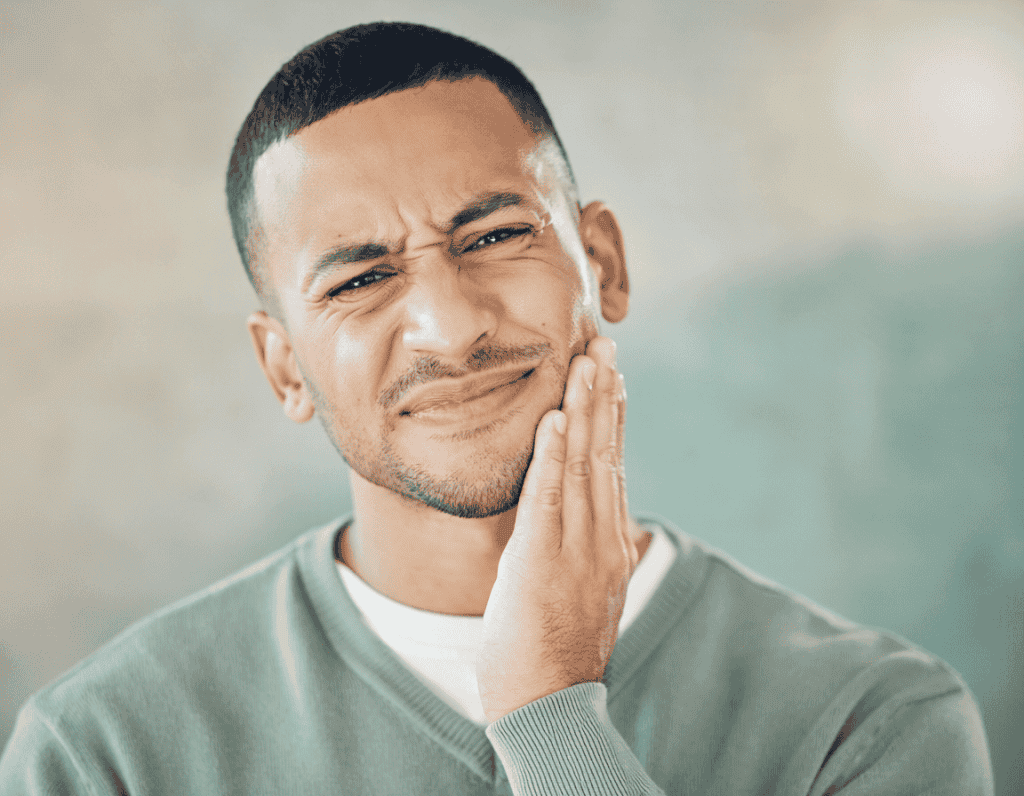
One-sided jaw pain usually develops from uneven stress: chewing on one side, nighttime clenching on one side, a tooth that sits too high, or a temporomandibular joint that works differently than the other. Less commonly, the cause is an inflammation, a wisdom tooth, or a sinus issue. Temporary discomfort often resolves on its own; if it lasts longer than two weeks or if you can no longer open your mouth properly, the cause should be investigated. This article helps you read your side — and decide whether and to whom you should go.
Why does jaw pain often occur on only one side?
The jaw is a paired system: on both sides, the temporomandibular joint and chewing muscles work together. If one side is stressed more than the other – for example, through one-sided chewing, misalignment, or nighttime clenching – overload can develop precisely there. This explains why symptoms often concentrate on one side while the other remains pain-free.
One-sided pain is not a separate condition but rather a symptom. The key is to identify the underlying cause.
Common causes of one-sided jaw pain
Overload from teeth grinding or clenching
One of the most common causes is nighttime overload of the chewing muscles. Those who unconsciously clench or grind often stress the temporomandibular joint unevenly – resulting in one-sided symptoms. If a sound also occurs, it’s worth looking at the topic of jaw popping and its causes, which is closely related.
Temporomandibular disorder (TMD)
When the load on the masticatory system becomes imbalanced, a temporomandibular disorder (TMD, often called TMJ) can develop. It manifests not only through jaw pain, but often also through headaches, neck pain, or ear discomfort – and frequently appears on one side first. How a structured diagnosis and treatment approach works is explained on our page about TMD pain therapy.
Misalignments and uneven bite
When the teeth don’t meet evenly, chewing pressure is distributed unevenly. One side then bears more load continuously, which can lead to localized pain. In such cases, the cause often lies in the bite itself.
Inflammation and acute triggers
Inflammation in the temporomandibular joint, an infection, or an injury can also cause one-sided pain. These symptoms usually appear acutely and should be evaluated by a professional soon.
Left or right — what the side reveals
The side itself says little about what the cause is — but a lot about where it sits. Ask yourself:
- Do you chew preferentially on this side? Many people chew one-sided without noticing — often because a tooth is missing on the other side, a filling interferes, or a tooth is sensitive. The chewing side becomes overloaded, the other forgets how to work.
- Is the pain in front of the ear, pinpoint? Then the joint is more likely affected. If it spreads across the cheek and temple, the muscles are more likely involved.
- Is it strongest in the morning? That suggests nighttime clenching or grinding — often stronger on one side, depending on sleeping position.
- Does your ear hurt at the same time, even though an ear specialist finds nothing? The temporomandibular joint and ear canal are only millimeters apart; joint pain is often felt as ear pain.
- Is a wisdom tooth coming in? In adolescents and young adults, a wisdom tooth in the lower jaw is one of the most common causes of one-sided pain at the back of the jaw — often with swelling of the gums.
- Do you have a cold or pressure in the upper jaw? A sinus infection radiates into the upper molars on one side.
What helps while the cause is still unclear: chew consciously on both sides, eat soft food, avoid chewing gum, keep your jaw relaxed during the day (teeth apart, lips together), and try the exercises from our article on jaw relaxation exercises.
Properly assessing one-sided jaw pain
The following questions help you better evaluate your symptoms – however, they do not replace a professional examination:
- When does the pain occur? In the morning after waking suggests nighttime clenching, while chewing suggests stress on the joint.
- Are there accompanying symptoms? Headaches, ear sounds, or neck tension can indicate TMD.
- How long have the symptoms been present? Sudden, severe pain differs from a gradually increasing feeling of pressure.
- Can you open your mouth normally? Restricted or painful mouth opening is an important signal.
If you answer yes to several of these questions, our TMD self-test helps with assessment — five minutes, no registration required. If the jaw joint pain persists, you should have the cause specifically investigated rather than just treating the symptom.
How is one-sided jaw pain examined?
The process begins with a detailed medical history, followed by a functional examination of both temporomandibular joints and the chewing muscles. The examination specifically compares how the pain-free side differs from the painful side. Modern procedures make it possible to precisely measure jaw movements and make dysfunctions visible. You can find more about this on our page about digital temporomandibular joint measurement.
Connection with Sleep and Nighttime Stress
If you wake up in the morning with one-sided jaw pain, muscle tension, and the feeling of unrefreshing sleep, you should also consider nighttime factors. Clenching, grinding, and breathing disorders during sleep are often connected. You can find information about when nighttime breathing interruptions require treatment in our section on snoring and sleep apnea.
When You Should Seek Medical Advice
Temporary, mild symptoms often resolve on their own. However, if the pain occurs repeatedly, persists for several weeks, worsens, or is accompanied by restricted mouth opening, professional evaluation is advisable. The earlier the cause is identified, the more specifically the one-sided stress on the masticatory system can be reduced. Feel free to schedule an appointment for evaluation.
- Schupp, W., Haubrich, J., & Funke, J. (2020). Behandlung mit Okklusionsschienen und deren Herstellung im digitalen Workflow. Informationen aus Orthodontie & Kieferorthopädie, 52(3), 227–231. https://doi.org/10.1055/a-1200-5934
- Schiffman, E., Ohrbach, R., Truelove, E., et al. (2014). Diagnostic Criteria for Temporomandibular Disorders (DC/TMD) for Clinical and Research Applications. Journal of Oral & Facial Pain and Headache, 28(1), 6–27. https://doi.org/10.11607/jop.1151
- Deutsche Gesellschaft für Funktionsdiagnostik und -therapie (DGFDT) & DGZMK. S3-Leitlinie: Diagnostik und Behandlung von Bruxismus. AWMF-Registernr. 083-027, Version 2.1 (Januar 2026). register.awmf.org
- Schupp, W., Haubrich, J., & Neumann, I. (2010). Invisalign treatment of patients with craniomandibular disorders. International Orthodontics, 8(3), 253–267. https://doi.org/10.1016/j.ortho.2010.07.010
Frequently Asked Questions About One-Sided Jaw Pain
Why does the jaw hurt only on one side?
Usually an unequal load on the masticatory system is the underlying cause – such as one-sided chewing, a misalignment, or nighttime clenching. As a result, the symptoms concentrate on one side while the other remains pain-free.
Is one-sided jaw pain a sign of TMD?
It can be an indicator, especially if accompanied by headaches, ear noises, or neck tension. Temporomandibular disorder often initially appears on one side. Only a functional examination can provide certainty.
When should I see a specialist with one-sided jaw pain?
If the symptoms persist for more than a few weeks, recur regularly, worsen, or restrict mouth opening, evaluation is advisable. Acute, severe pain should be examined soon.
Can an uneven bite cause one-sided pain?
Yes. If the teeth do not meet evenly, the chewing pressure is distributed unevenly. One side then bears a permanently greater load, which can lead to localized symptoms.
Can a wisdom tooth cause one-sided jaw pain?
Yes. An erupting or impacted wisdom tooth in the lower jaw is a common cause of pain at the back of the jaw on one side in adolescents and young adults, often with swollen gums. Your dentist will clarify this with an X-ray.
Why does my ear hurt when I have jaw pain?
The temporomandibular joint and ear canal are close together. An irritated joint or tense chewing muscles are therefore often felt as ear pain — even when the ear itself is healthy.

Dr. Julia Steinmaier
Specialist in orthodontics. Owner of JUST KFO in Cologne, sought-after speaker and author who regularly appears in professional publications and media.
Full profile →Related Posts
These blog posts might also interest you.
 Dec 15, 2024TMJ Pain: Causes and Treatment OptionsRead more →
 Jun 17, 2026TMD Symptoms in Women: Why Complaints Often Go UnrecognizedRead more →Mar 16, 2025How to get rid of jaw clicking and popping – causes, consequences and treatmentRead more →
Reviewed by Dr. med. dent. Julia Steinmaier, specialist in orthodontics · Last reviewed on September 6, 2026
Your orthodontist in Cologne!
Schedule your no-obligation consultation at JUST KFO – Dr. Steinmaier & Kollegen in Cologne.