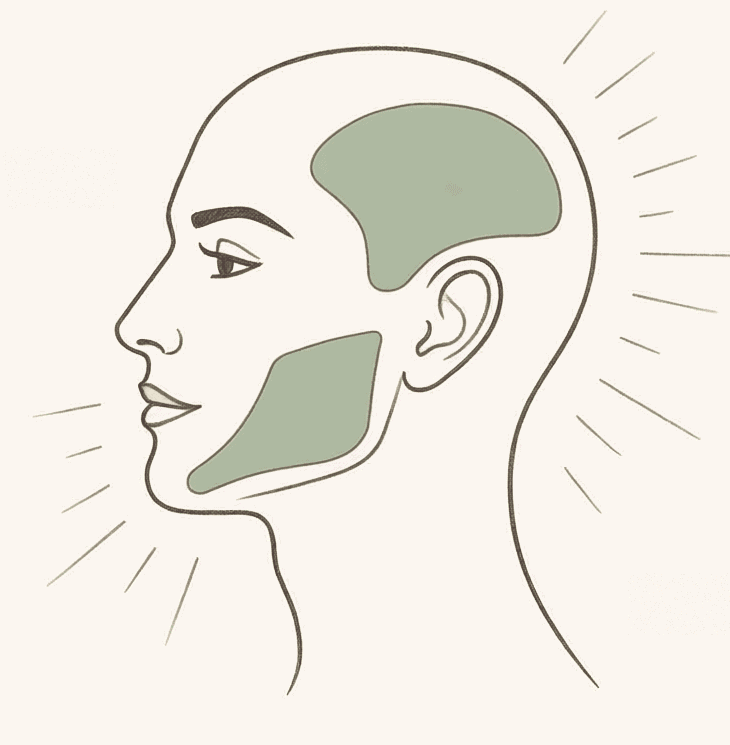
Place your fingertips on your cheek, two fingers’ width in front of your earlobe, and bite down briefly. The muscle that bulges is the masseter – the large chewing muscle on the side of your cheek. It is the most common source of jaw tension and the muscle targeted by the following jaw relaxation exercises.
The first exercise lasts 30 seconds, and you can do it while reading. All seven come from the repertoire of physical therapy for temporomandibular disorder (TMD, often called TMJ). A meta-analysis of 16 randomized trials attributes small to moderate effects on pain and mouth opening to exercise therapy in craniomandibular dysfunctions.1 They are suitable for daily self-application – preventively for stress-related tension as well as accompanying orthodontic treatment.
At a Glance: Three exercises cover the most common tension patterns and can be completed in about five minutes: the masseter massage (Exercise 1), controlled mouth opening (Exercise 3), and tongue resting position (Exercise 7).
When exercises are not enough: If symptoms persist for several weeks, mouth opening is restricted, or the temporomandibular joint pops, a temporomandibular disorder (TMD) may be the underlying cause. How to recognize it →
What happens in the body during jaw tension?
Jaw tension develops when the masticatory muscles remain under constant tension and no longer release on their own. The four main masticatory muscles – masseter, temporalis, medial pterygoid, and lateral pterygoid – are, measured by their cross-section, among the most powerful muscles in the body.
If this musculature remains tense for hours or days, pressure-sensitive points can form in the muscle, called trigger points in physical therapy. Pain can radiate from these to other regions – particularly described are temples, ears, neck, and shoulders. This explains why jaw complaints often occur together with headaches, ear sounds, or neck tension. For tinnitus, the connection is well studied: A systematic review of 32 studies finds a clear association between TMD and tinnitus.4 How this connection arises, however, has not yet been clarified.
The main triggers are teeth grinding and clenching (bruxism), psychological stress, persistently unfavorable posture, and an existing functional disorder of the temporomandibular joint. The role that occlusion plays in this is professionally disputed – the current S3 guideline on bruxism states that occlusion represents “if at all” no causal factor.2 What comes together in your case can be narrowed down in the consultation and clinical functional examination.
The 7 most effective jaw relaxation exercises for home use
The following exercises build on each other: Exercises 1 and 2 release acute tension through massage, Exercises 3 to 5 mobilize the jaw joint, Exercises 6 and 7 train the resting position for daily life. Perform the exercises in front of a mirror so you can monitor correct movement.
Exercise 1: Masseter massage for acute tension
The masseter massage releases the most common source of jaw tension — the large chewing muscle on the side of the cheek. Locate the muscle by gently clenching your teeth: the masseter will bulge noticeably on the side of the jaw.
- Place your index and middle fingers of both hands on the masseter muscles on both cheeks.
- Massage with gentle, circular pressure for about 30 seconds. Breathe calmly through your nose during this time.
- Look for hardened points and hold the pressure there for 20 to 30 seconds until the tension eases.
- Repeat the massage two to three times a day, especially after stressful periods.
Effect: Blood circulation in the masticatory muscles can improve and tension can release. Some people feel relief after a single application, others need several weeks of regular practice.
Exercise 2: Temporalis Massage for Temple Headaches
The temporalis muscle is the second major jaw muscle and sits laterally on the head above the ears. Tension in this muscle can trigger pain in the temple and forehead. Whether recurring headache stems from a headache disorder, a muscular cause, or both should be medically evaluated.
- Place your fingertips of both hands on your temples, about two finger-widths above the ear.
- Massage with circular movements from the ear upward toward the forehead — about 60 seconds per side.
- Bite down gently in between to feel the course of the muscle and massage it more precisely.
- End the exercise with two minutes of quiet sitting so the released muscle can adapt to the new tension level.
Exercise 3: Controlled Jaw Opening with Tongue Contact
Controlled mouth opening trains symmetrical movement of the lower jaw. Controlled opening exercises are part of the physiotherapeutic TMD treatment.1
- Sit upright and place the tip of your tongue behind your upper front teeth against the palate.
- Open your mouth slowly, as long as your tongue can maintain contact with the palate.
- Hold the maximum opening for two seconds and close your mouth again just as slowly.
- Ten repetitions, three times a day.
Important: The exercise should be pain-free. If your jaw clicks, pops, or shifts to the side during the exercise, stop and schedule an appointment for functional diagnostics. A persistently one-sided movement pattern suggests a structural change in the temporomandibular joint.
Exercise 4: Isometric Resistance Training for the Jaw Muscles
Isometric exercises activate the jaw muscles without moving the jaw joint. They are part of movement therapy programs for temporomandibular disorders.
- Place a fist under your chin and try to open your mouth against the resistance of your fist. Hold for 5 seconds while exhaling.
- Press a palm from the right against your lower jaw and push your jaw to the right with light pressure against the resistance. Hold for 5 seconds.
- Repeat the lateral exercise on the left side.
- Five rounds per direction, once a day.
Exercise 5: Jaw-Neck Stretch to Balance the Muscle Chain
The jaw and neck are functionally connected; complaints in both regions often occur together. The following stretch addresses both areas.
- Sit upright and slowly tilt your head toward your right shoulder until you feel a stretch on the left side of your neck.
- Place your right hand gently on the left temple area—without applying pressure, just as additional weight.
- Hold the position for 30 seconds and breathe calmly through your nose.
- Switch sides. Twice per side, once daily.
Exercise 6: Heat Application for Deep Relaxation
Moist heat is often recommended for self-treatment of jaw complaints; many find it relaxing for the muscles. No comparison with other methods can be derived from this. As an evening ritual, it can be combined well with relaxation and breathing exercises — the updated S3 guideline on bruxism explicitly recommends such self-help measures.2
- Warm a damp towel or grain pillow to about 40 degrees Celsius—warm, but not too hot for the skin.
- Place it on both cheeks over the masseter region for 10 to 15 minutes.
- Close your eyes and breathe deeply into your abdomen—at least 6 seconds inhaling, 8 seconds exhaling.
Afterward, the masseter massage from Exercise 1 can be added easily.
Exercise 7: Training Tongue Resting Position—The Most Important Daily Exercise
The tongue rest position targets the behavior that sustains many jaw tensions: unconscious clenching of the teeth while awake. This is exactly where the self-observation described in the S3 guideline on bruxism as a component of self-management comes in.2 In the physiological rest position, the upper and lower jaws do not touch, the lips are loosely closed, the tongue rests relaxed on the palate.
- Place the tip of your tongue behind the upper front teeth on the palate.
- Let your lower jaw hang loosely so that a gap of about 2 to 3 millimeters forms between the rows of teeth.
- Close your lips in a relaxed manner—without pressure.
- Anchor this position as your daily standard: remind yourself every 30 minutes until it becomes automatic.
This exercise does not work overnight, but over weeks. Those who make the tongue rest position a habit work on the baseline tension of the jaw rather than only on acute tension.
Exercises for Disc Displacement: What Helps – and What You Should Avoid
When the jaw pops during opening, a disc displacement is often the cause: the small cartilage disc in the temporomandibular joint has slipped forward and snaps back when opening. As long as the popping occurs without pain and without limitation, exercises 3, 5, and 7 from this article are useful – controlled mouth opening with tongue contact trains a straight, joint-friendly movement, the jaw-neck stretch releases tension from the muscle chain, and the resting tongue position relieves the joint in everyday life. Important: open small, not until the pop, and do not “click through” with force.
It is different when the mouth suddenly opens only to a limited extent, the popping has disappeared, and instead a feeling of blockage or pain occurs. In this case, the disc may be permanently positioned in front of the condyle – a disc displacement without reduction. In this situation, you should not exercise against resistance and should not force the jaw open with your hands; this can further irritate the joint structures. What happens in the joint in both cases is explained in the FAQ on disc displacement on our TMD page. A newly occurring limitation in mouth opening should be seen in the practice soon – the earlier a blocked disc is treated, the better the mobility can often be restored.
When Jaw Relaxation Exercises Are No Longer Sufficient
Exercises can relieve muscular complaints. They do not clarify whether a structural cause is present. If the following warning signs occur, the findings should be medically evaluated — not answered with even more exercises.
- Pain occurs daily and persists for longer than 4 weeks.
- The jaw pops, jumps, or locks when opening or closing.
- Mouth opening is restricted — fewer than three fingers fit vertically between the incisors. This is a guide; the clinical examination measures mouth opening in millimeters.3
- Headaches, earaches, tinnitus, or dizziness accompany the jaw symptoms.
- You wake up in the morning with jaw pain or tense jaw muscles—a typical sign of nighttime grinding.
- The exercises worsen the symptoms instead of relieving them.
In such cases, a temporomandibular disorder (TMD, often called TMJ) may be present — a functional disorder of the temporomandibular joint that can persist over time if left untreated. The diagnosis is based on clinical examination; internationally, the Diagnostic Criteria for Temporomandibular Disorders (DC/TMD) are the standard.3 In addition, instrumental functional analysis can measure jaw movement three-dimensionally and compare it with the individual anatomy.
If you’re unsure how many of these signs apply to you and what they mean: Our TMD self-assessment walks you through the same indicators in a structured way — anonymous, no registration required, in about two minutes. It’s based on the DC/TMD symptom questionnaire and the Hamburg TMD short screening, meaning the same screening questions that begin the in-office examination. It does not replace a diagnosis.
The most common causes of jaw tension
Jaw relaxation exercises work better when you know the underlying cause and address it at the same time. Four causes are most common in practice:
Nighttime teeth grinding (bruxism)
In sleep bruxism, conscious control over the duration and intensity of clenching is absent. The result: the masticatory muscles are overloaded in the morning, the teeth are worn down, and the temporomandibular joints are stressed. However, the updated S3 guideline no longer categorizes bruxism in otherwise healthy individuals as a disorder per se, but rather as a behavior or risk factor depending on its severity.2 A night guard can protect tooth structure from further wear; in painful TMD, meta-analyses show that occlusal splints reduce pain compared to placebo splints.5 Which splint is appropriate when and how it is fabricated is professionally regulated.7 For more on causes and consequences, read the article on teeth grinding and its causes.
Stress and psychological strain
The updated S3 guideline attributes awake bruxism more to psychosocial stress, and sleep bruxism more to central nervous system control.2 Relaxation techniques — progressive muscle relaxation according to Jacobson, breathing exercises — are explicitly recommended there as self-help measures and complement the physical exercises.
Occlusion — a controversial factor
For a long time, a single premature contact—a tooth that strikes a millimeter earlier than the others when biting—was considered the trigger for a muscular chain reaction. This concept is scientifically disputed: a review in the Primary Dental Journal concludes that the literature provides no disease-specific link between occlusion and TMD6; the S3 guideline on bruxism states that occlusion—if anything—is not a causal factor.2 Therefore, we do not begin orthodontic treatment as therapy for jaw tension. It can be meaningful when an orthodontic finding is, by itself, in need of treatment. If such treatment is considered while TMD is present, function becomes part of the planning—for aligner therapy in the presence of temporomandibular disorder, this is described in the professional literature, including in a publication from our practice.8
Restricted airways and mouth breathing
With chronic mouth breathing, the tongue rests at the floor of the mouth instead of at the palate; the lower jaw drops, and the airways narrow further. How much this strains the masticatory muscles must be assessed on a case-by-case basis.
What you can do in addition to your exercise routine
Exercises work best when everyday life supports relaxation instead of sabotaging it. These four behavioral changes significantly enhance the effect of the exercises:
- Reduce hard and chewy foods: Chewing gum, baguette crust, nuts, or tough meat strain the chewing muscles over long periods. Choose softer foods during phases of acute tension.
- Correct screen posture: The monitor should be at eye level, with shoulders relaxed. Whether head posture measurably strains the temporomandibular joint is not definitively established—for the neck and shoulders, an upright screen posture is a relief nonetheless.
- Actively reduce stress: Regular exercise and relaxation techniques are among the self-help measures recommended by the S3 guideline on bruxism.2
- Check sleeping position: Anyone who sleeps on their stomach presses the jaw one-sidedly into the mattress. There is no reliable evidence that changing sleeping position relieves jaw discomfort—but trying it costs nothing.
Tension that won’t go away?
If jaw relaxation exercises don’t bring noticeable improvement after several weeks, a professional examination is worthwhile. In our practice in Cologne, we perform instrumental functional analysis using the DMD system – a three-dimensional recording of your jaw movement that complements the clinical examination. Book an appointment for TMD diagnostics.
If your symptoms are related to nighttime teeth grinding or restless sleep, you will find further information on splint therapy on our page about snoring & sleep apnea .
Jaw relaxation exercises are a start — not the complete solution
The seven exercises in this guide cover what you can do yourself right away: relieve acute tension, train the resting position, and reduce strain on the jaw in everyday life. How quickly something changes varies from person to person. In studies on exercise therapy for TMD, the effects on pain and mouth opening are small to moderate1 – noticeable, but not automatic.
If the symptoms still return or radiate from the beginning into the ear, temple, or neck, there may be an underlying cause that the exercises cannot reach. This is precisely where instrumental functional analysis comes in: it makes visible what the exercises cannot reach – the movement of the temporomandibular joint down to the millimeter.
- Idáñez-Robles, A. M., Obrero-Gaitán, E., Lomas-Vega, R., et al. (2023). Exercise therapy improves pain and mouth opening in temporomandibular disorders: A systematic review with meta-analysis. Clinical Rehabilitation, 37(4), 443–461. https://doi.org/10.1177/02692155221133523
- Deutsche Gesellschaft für Funktionsdiagnostik und -therapie (DGFDT) & DGZMK. S3-Leitlinie: Diagnostik und Behandlung von Bruxismus. AWMF-Registernr. 083-027, Version 2.1 (Januar 2026). register.awmf.org
- Schiffman, E., Ohrbach, R., Truelove, E., et al. (2014). Diagnostic Criteria for Temporomandibular Disorders (DC/TMD) for Clinical and Research Applications. Journal of Oral & Facial Pain and Headache, 28(1), 6–27. https://doi.org/10.11607/jop.1151
- De La Torre Canales, G., Christidis, N., Grigoriadis, A., et al. (2025). Associations between temporomandibular disorders and tinnitus – a systematic review. Cranio, 43(6), 969–985. https://doi.org/10.1080/08869634.2024.2404270
- Deutsche Gesellschaft für Funktionsdiagnostik und -therapie (DGFDT) & DGZMK. S2k-Leitlinie: Okklusionsschienen zur Behandlung craniomandibulärer Dysfunktionen und zur präprothetischen Therapie. AWMF-Registernr. 083-051, Version 1.0 (Februar 2024). register.awmf.org
- Al-Ani, Z. (2020). Occlusion and Temporomandibular Disorders: A Long-Standing Controversy in Dentistry. Primary Dental Journal, 9(1), 43–48. https://doi.org/10.1177/2050168420911029
- Schupp, W., Haubrich, J., & Funke, J. (2020). Behandlung mit Okklusionsschienen und deren Herstellung im digitalen Workflow. Informationen aus Orthodontie & Kieferorthopädie, 52(3), 227–231. https://doi.org/10.1055/a-1200-5934
- Schupp, W., Haubrich, J., & Neumann, I. (2010). Invisalign treatment of patients with craniomandibular disorders. International Orthodontics, 8(3), 253–267. https://doi.org/10.1016/j.ortho.2010.07.010
Frequently asked questions about jaw relaxation exercises
How often should I do jaw relaxation exercises?
Two to three times daily for 5 to 10 minutes each is recommended. The masseter massage (Exercise 1) is particularly suitable after stressful phases or before bedtime, while the tongue resting position (Exercise 7) should be consciously maintained throughout the day. How quickly something changes varies individually – give the routine at least two to three weeks.
Can I relieve jaw tension myself or do I need medical help?
Functional jaw tension can in many cases be relieved through consistent exercises over 4 to 6 weeks. However, if a structural cause is present — such as disc displacement in the temporomandibular joint, malocclusion, or temporomandibular disorder — exercises alone are not sufficient. Professional functional diagnostics are necessary at the latest after 4 weeks without improvement or when pain radiates into the ear, temple, or neck.
Which exercise helps fastest against acute jaw pain?
The masseter massage (Exercise 1) in combination with heat application (Exercise 6) is experienced by many as short-term relief. Important: This immediate measure does not replace clarifying the cause in case of recurring symptoms.
Can jaw relaxation exercises stop teeth grinding?
Exercises reduce muscle tension during the day and can thereby lessen nighttime teeth grinding – but usually do not stop it completely. For bruxism, a custom-made occlusal splint may be considered, especially to protect the tooth enamel.5 The updated S3 guideline also recommends relaxation and breathing exercises as self-help.2 Exercises and splint complement each other – the splint works at night, the exercises during the day.
What is the correct resting position of the jaw?
In the physiological resting position, the tongue rests on the palate, the lips are loosely closed, and there is a gap of 2 to 3 millimeters between the upper and lower teeth. Many people unconsciously press their teeth together – this is considered a significant factor for jaw tension that develops during the day. The tongue resting position (Exercise 7) trains this correct position.
Do jaw relaxation exercises also help with tinnitus or ear pain?
Tinnitus and ear pain can be caused or intensified by tense jaw muscles – particularly the lateral pterygoid muscle – because it attaches directly to the temporomandibular joint and thus near the inner ear. TMD and tinnitus occur together more frequently than by chance.4 Whether there is a functional connection in an individual case cannot be concluded from this – that requires both ENT and dental examination side by side.
When should I start using a night guard or begin orthodontic treatment?
A night guard is appropriate as soon as morning jaw pain, tooth wear, or partner reports of nighttime grinding occur. Orthodontic treatment comes into play when an orthodontic finding is independently in need of treatment. As a therapy for tension itself, it is not supported by evidence.6 When both exist side by side, we plan the treatment and splint therapy in coordination with each other.

Dr. Julia Steinmaier
Specialist in orthodontics. Owner of JUST KFO in Cologne, sought-after speaker and author who regularly appears in professional publications and media.
Full profile →Related Posts
These blog posts might also interest you.
 Jun 17, 2026Teeth Grinding Causes: 7 Reasons Why You Grind Your Teeth at NightRead more →
 Mar 16, 2025How to get rid of jaw clicking and popping – causes, consequences and treatmentRead more →Dec 15, 2024TMJ Pain: Causes and Treatment OptionsRead more →
Reviewed by Dr. med. dent. Julia Steinmaier, specialist in orthodontics · Last reviewed on June 21, 2026
Your orthodontist in Cologne!
Schedule your no-obligation consultation at JUST KFO – Dr. Steinmaier & Kollegen in Cologne.