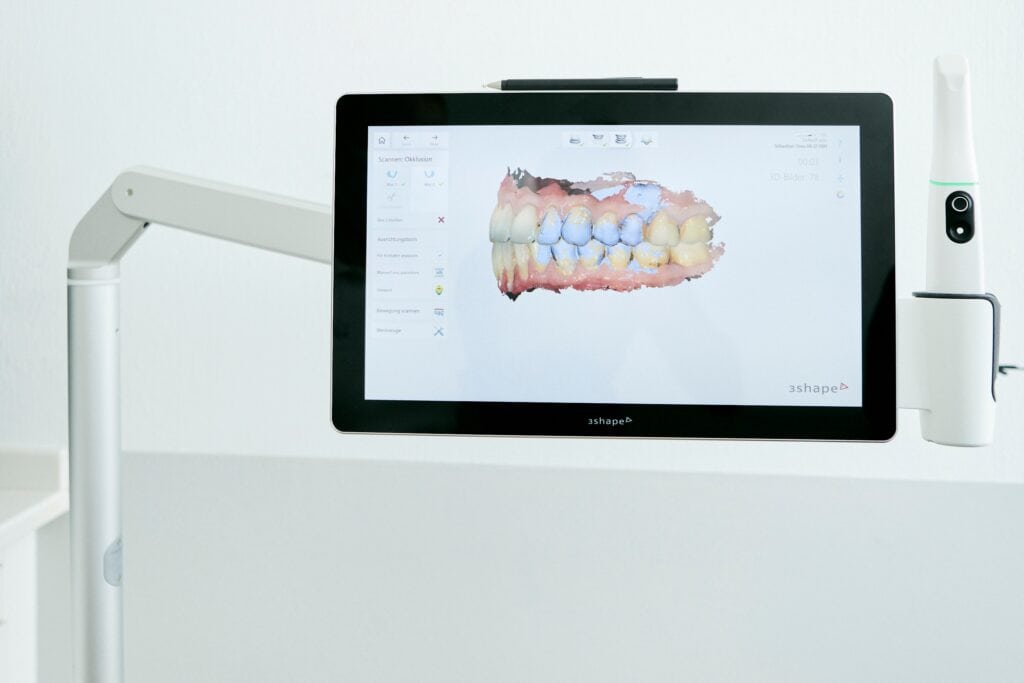
Many people recall traditional dental impressions with unease: the tray, the cold impression material, the uncomfortable pressure in the mouth.
The good news: that’s a thing of the past.
Using the most advanced digital technology — the so-called intraoral scanner — we at JUST KFO in Cologne create precise 3D images of your teeth, entirely without impression material.
The result: greater comfort, maximum accuracy, and a far more pleasant treatment — from planning through to the finished braces or alignertherapy.
What does “braces without impressions” mean?
With digital impression-taking, an intraoral scanner is used instead of conventional silicone or alginate material.
This small, handheld device scans the dental arches with a camera and creates an exact 3D model of the jaw within minutes..
The digital model completely replaces the traditional impression and serves as the basis for:
-
digital treatment planning,
-
fabrication of braces or aligners,
-
precise progress monitoring during treatment.
How the intraoral scan works
The scan is performed directly in the practice — contactless, painless, and in real time.
Our orthodontists guide the scanner gently over the tooth surfaces. Thousands of individual images are immediately assembled into a high-resolution 3D image.
Your advantages:
-
No gag reflex, no unpleasant taste
-
Immediately visible result on the screen
-
Maximum precision in treatment planning
-
Digital data storage without physical models
-
Faster fabrication of appliances or aligners
This makes the first step toward new braces more comfortable than ever before.
Digital orthodontics: How patients benefit
Digital technology enables us to design treatments even more individually, precisely, and efficiently.
Especially in complex cases, the digital data foundation is a decisive advantage.
Precise treatment planning
The 3D model shows even the smallest details of teeth and gums.
This allows tooth movements to be simulated with precision — for example, in aligner treatments or fixed braces.
High fit accuracy
Braces, retainers , and aligners are fabricated digitally based on the scan.
This ensures an optimal fit and greater wearing comfort — without tedious adjustments.
Faster treatment start
Because no plaster impression needs to be made and shipped, the waiting time until treatment begins is noticeably reduced.
Digital progress monitoring
With regular scans, treatment progress can be digitally documented and compared. This allows us to check at any time whether everything is proceeding as planned.
Braces without impressions — for children and adults
The intraoral scanner is suitable for patients of all ages.
Especially for children who are anxious about the traditional impression, the digital alternative provides a relaxed experience.
Adults benefit as well: Particularly with discreet treatments such as Invisalign or ceramic braces, precision plays a crucial role – and digital technology delivers highly precise results.
From digital scan to custom braces
After the scan, the 3D model is transferred directly into our planning software.
There we simulate the tooth movement, discuss the planned result with you, and can even show you a digital preview of your future smile.
Subsequently, the corresponding appliances — whether fixed or removable — are custom-fabricated:
-
Aligners (clear trays)
-
Fixed braces with custom-fitted brackets
-
Retainers to stabilize the result
This creates a fully digital workflow — precise, hygienic and sustainable.
Intraoral scanner vs. traditional impression — the comparison
| Feature | Traditional impression | Digital intraoral scan |
|---|---|---|
| Comfort | Often unpleasant, gag reflex possible | Pain-free, without impression material |
| Duration | Several minutes + setting time | Completed in a few minutes |
| Precision | Risk of distortions or bubbles | Exact 3D representation |
| Hygiene | Multiple steps, material contact | Contactless, digitally stored |
| Treatment speed | Model fabrication required | Immediate further processing |
| Environmental friendliness | High material consumption | No plaster or silicone required |
Digital braces — what does that mean exactly?
The term “digital braces” refers to the use of digital technologies throughout the entire orthodontic treatment process:
from diagnosis through planning to the fabrication of appliances.
At JUST KFO we combine the intraoral scan with other modern tools:
-
3D planning software for exact simulation of tooth movement
-
Digital bracket positioning for maximum precision
-
Transparent communication: You see your result before treatment begins
This creates trust and confidence — for you and for us.
When is an intraoral scan particularly recommended?
A digital scan is especially suitable when:
-
new braces or aligner therapy are being planned,
-
a check of treatment progress is due,
-
a renewal of retainers or appliances is needed,
-
or a digital archive of your dental situation is desired.
The scan is also helpful for TMDpatients , as jaw movement and bite situation can be captured precisely.
The future of orthodontics: Precise, digital and patient-friendly
The digital impression has long been more than just a technical innovation – it represents genuine progress in modern orthodontics.
Patients experience greater comfort, we achieve more precise results, and treatment can begin more quickly.
At JUST KFO in Cologne , we use digital technology strategically to provide you with the best possible experience — from the first scan to your perfect smile.
Braces without impression in Cologne — experience modern orthodontics at JUST KFO
If you want orthodontic correction but prefer to avoid the traditional impression, the digital intraoral scan is the ideal solution.
Our practice JUST KFO in Cologne is among the most modern orthodontic facilities in the region — with one clear goal:
to provide you with gentle, precise, and comfortable treatment.
Feel free to schedule an appointment for a personal consultation — we’ll show you how pleasant orthodontics can be today.
- Schupp, W., Funke, J., & Haubrich, J. (2020). Der digitale Workflow in der In-Office-Alignertherapie. Informationen aus Orthodontie & Kieferorthopädie, 52(4), 289–300. https://doi.org/10.1055/a-1241-9967
- Kravitz, N. D., Kusnoto, B., BeGole, E., Obrez, A., & Agran, B. (2009). How well does Invisalign work? A prospective clinical study evaluating the efficacy of tooth movement with Invisalign. American Journal of Orthodontics and Dentofacial Orthopedics, 135(1), 27–35. https://doi.org/10.1016/j.ajodo.2007.05.018
- Rossini, G., Parrini, S., Castroflorio, T., Deregibus, A., & Debernardi, C. L. (2015). Efficacy of clear aligners in controlling orthodontic tooth movement: A systematic review. The Angle Orthodontist, 85(5), 881–889. https://doi.org/10.2319/061614-436.1
Frequently asked questions about braces without impression
How does digital dental impression with the intraoral scanner work?
The intraoral scanner captures the dental arches with a small camera and creates a precise 3D model of the jaw within just a few minutes. No impression material is used, making the process more comfortable and faster for patients.
Is digital impression suitable for all age groups?
Yes, digital impression-taking is suitable for children, adolescents, and adults alike. It offers a particularly comfortable alternative for patients who experience gag reflex or have anxiety about traditional impressions.
What advantages does a braces treatment without traditional impression offer?
The digital method avoids unpleasant impression materials, reduces gag reflex, and enables faster and more precise planning as well as fabrication of braces. Additionally, the treatment outcome can be digitally visualized early in the process.
How accurate is digital dental impression compared to conventional impression?
Digital impression provides a highly precise 3D representation of the teeth and jaw in real time. This allows braces and appliances to be fabricated with a better fit, which improves wearing comfort and treatment effectiveness.
Who covers the costs for digital impression-taking?
The costs for digital dental impression vary depending on the practice and treatment. They are typically covered by private health insurance, while statutory health insurance usually does not cover these costs. It’s advisable to seek individual consultation in advance.

Dr. Julia Steinmaier
Specialist in orthodontics. Owner of JUST KFO in Cologne, sought-after speaker and author who regularly appears in professional publications and media.
Full profile →Related Posts
These blog posts might also interest you.
 Dec 21, 2024Invisalign Costs: Your Guide from JUST KFORead more →
 Mar 16, 2025Invisalign and Aligners: Advantages and Disadvantages at a GlanceRead more →
 Jun 17, 2026Non-Covered Services in Orthodontics: What Statutory Insurance Patients Pay ExtraRead more →
Reviewed by Dr. med. dent. Julia Steinmaier, specialist in orthodontics · Last reviewed on June 27, 2026
Your orthodontist in Cologne!
Schedule your no-obligation consultation at JUST KFO – Dr. Steinmaier & Kollegen in Cologne.