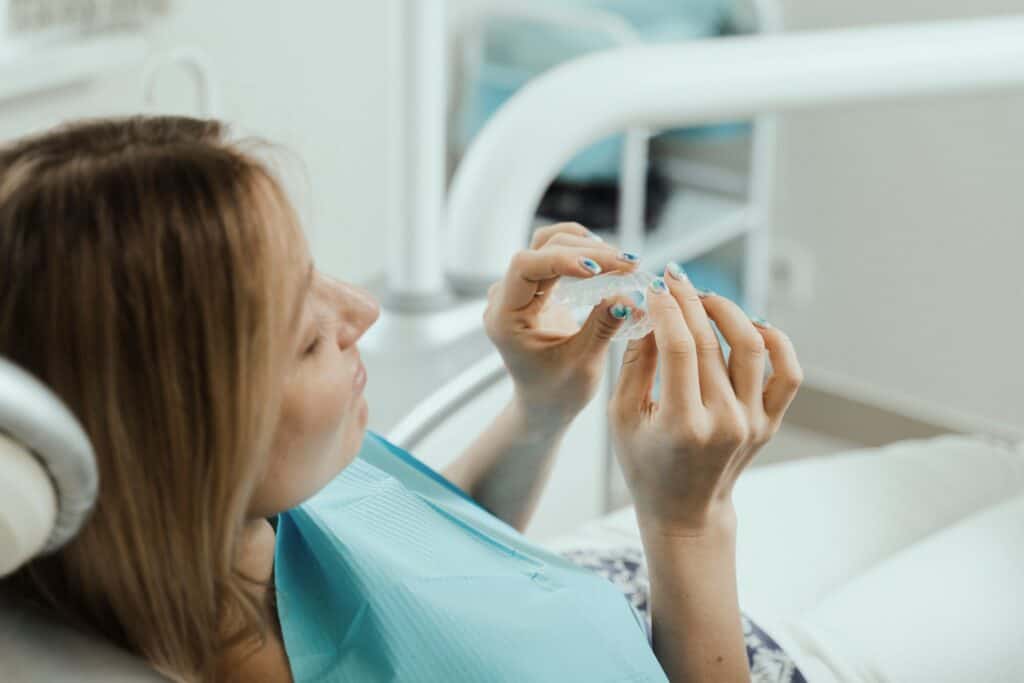
What this is about: the most common misconceptions about braces – especially among adults considering treatment. What a treatment costs and who pays for it is covered in What does a dental aligner cost? and Non-Contracted Services. About the treatment itself: Orthodontics for Adults.
Many misconceptions about braces persist stubbornly. We take a closer look at the biggest braces myths.
Braces are no longer just a topic for children and teenagers – many adults today also consciously choose orthodontic treatment. At the same time, many myths and misconceptions about braces still circulate, which can cause uncertainty or deter people from taking the step toward treatment.
In this article, we at JUST KFO in Cologne-Rodenkirchen clarify the most common misconceptions – clearly, scientifically sound, and with one goal: to give you confidence in your decision.
Myth 1: “Braces are only for kids and teenagers”
False. More and more adults are undergoing orthodontic treatment – and for good reasons. Whether for cosmetic purposes, bite correction, or preparation for dental prosthetics: braces are effective at any age, as long as teeth and supporting structures are healthy. Thanks to modern, discreet systems like ceramic braces or aligners, treatment often goes barely noticed in daily life.
Myth 2: “Braces are always visible and embarrassing”
This notion is long outdated. Modern braces systems offer diverse options: transparent ceramic braces, self-ligating mini brackets, or nearly invisible aligners. These variants are ideal especially for working professionals. Tooth corrections can be implemented discreetly and effectively – without unwanted attention.
Myth 3: “Braces are always expensive and unaffordable”
Treatment costs vary depending on the method, duration, and individual requirements. Important to know: For children and adolescents, statutory health insurance covers standard care if the misalignment is classified at least as treatment need level 3 of the orthodontic indication groups (KIG).4 The health insurance covers 80 percent of the costs directly; the 20 percent co-payment is reimbursed after successful completion of treatment.5 Adults may benefit from private supplemental insurance or individual financing options under certain conditions. At JUST KFO , we provide transparent consultation and work with you to find the right solution.
Myth 4: “With fixed braces, I can’t eat anything anymore”
Of course, there are restrictions – especially with very hard or sticky foods. But your diet doesn’t have to become monotonous. Most favorite dishes remain perfectly possible. We also give you tips on how to adjust your diet easily during treatment without sacrificing enjoyment.
Myth 5: “Braces always cause severe pain”
Some adjustment period is normal – especially right after insertion or at follow-up appointments. But today’s braces work with comparatively low forces. Modern brackets and materials are designed to work gently and efficiently. A feeling of pressure in the first few days is normal. If that is not enough, pain relievers are an option: A Cochrane Review finds a benefit over placebo but rates the evidence as moderate to low.1 If severe discomfort persists, it should be discussed in the practice – not endured.
Myth 6: “Treatment takes forever”
How long treatment takes depends on the individual starting situation – minor misalignments can often be corrected in just a few months. More complex cases require more time; a systematic review of treatment with fixed braces cites approximately 20 months as a general range, with considerable variation depending on the findings.2 Thanks to modern treatment methods, precise planning, and digital diagnostics , the process can be controlled more efficiently and precisely than ever before.
Myth 7: “Braces make oral hygiene impossible”
The truth: With fixed braces, oral hygiene is somewhat more involved. It’s false that it becomes impossible. With special tools—interdental brushes, floss threaders, an electric toothbrush—thorough cleaning is quite manageable. It does, however, require more time and more consistency than before. Whether additional fluoride protects against decalcification around the brackets has been examined in a Cochrane review; the certainty of evidence is explicitly stated as low.3 For practical instructions on cleaning, see Cleaning Your Braces. We at JUST KFO give you practical tips and show you how to care for your teeth optimally even during treatment.
Myths debunked, decision made easier
Many of the preconceptions surrounding braces are based on outdated information or half-knowledge. Yet modern orthodontics today is more diverse, discreet and comfortable than ever before. What matters is individual consultation — and that’s exactly what you receive at our practice JUST KFO in Cologne-Rodenkirchen.
Together we’ll find the path to a healthy bite — and a smile that suits you.
Book a consultation appointment now
Frequently asked questions about myths surrounding braces
Are braces only for children and adolescents?
No. Teeth corrections are possible at any age, as long as teeth and supporting structures are healthy. Especially among adults, discreet aligners are very popular. The proportion of adult patients has been rising for years.
Are braces always visible?
No. In addition to traditional metal brackets, there are tooth-colored ceramic brackets and clear aligners. For many cases, an inconspicuous solution is available today.
Does wearing braces always cause severe pain?
No. After placement or adjustment, a pressure sensation is normal, which usually subsides after a few days. Severe, lasting pain is not the norm — if discomfort persists, please speak with us.
Can I not eat anything with fixed braces?
You can eat almost everything. Very hard, sticky or chewy foods should be avoided to prevent damage to brackets and wires. Otherwise, normal eating is entirely possible.
Are braces always expensive and unaffordable?
Not across the board. For children and adolescents, statutory health insurance covers treatment starting at a certain severity of misalignment (KIG 3–5); the 20 percent co-payment is refunded after successful completion. For private services, we prepare transparent cost estimates, usually with installment payment options. Costs depend heavily on the individual diagnosis.
- Monk, A. B., Harrison, J. E., Worthington, H. V., & Teague, A. (2017). Pharmacological interventions for pain relief during orthodontic treatment. Cochrane Database of Systematic Reviews, Issue 11, Art. No.: CD003976. https://doi.org/10.1002/14651858.CD003976.pub2
- Tsichlaki, A., Chin, S. Y., Pandis, N., & Fleming, P. S. (2016). How long does treatment with fixed orthodontic appliances last? A systematic review. Am J Orthod Dentofacial Orthop, 149(3), 308–318. https://doi.org/10.1016/j.ajodo.2015.09.020
- Benson, P. E., Parkin, N., Dyer, F., Millett, D. T., & Germain, P. (2019). Fluorides for preventing early tooth decay (demineralised lesions) during fixed brace treatment. Cochrane Database of Systematic Reviews, Issue 11, Art. No.: CD003809. https://doi.org/10.1002/14651858.CD003809.pub4
- Gemeinsamer Bundesausschuss. Richtlinien für die kieferorthopädische Behandlung. g-ba.de/richtlinien/28
- § 29 SGB V – Kieferorthopädische Behandlung. gesetze-im-internet.de/sgb_5/__29.html
Legal status of information regarding statutory health insurance coverage: August 27, 2026.

Dr. Julia Steinmaier
Specialist in orthodontics. Owner of JUST KFO in Cologne, sought-after speaker and author who regularly appears in professional publications and media.
Full profile →Related Posts
These blog posts might also interest you.
 Jun 17, 2026Non-Covered Services in Orthodontics: What Statutory Insurance Patients Pay ExtraRead more →
 Mar 16, 2025Invisalign and Aligners: Advantages and Disadvantages at a GlanceRead more →Mar 16, 2025Braces pain – What to do? Tips and tricksRead more →
Reviewed by Dr. med. dent. Julia Steinmaier, specialist in orthodontics · Last reviewed on September 6, 2026
Your orthodontist in Cologne!
Schedule your no-obligation consultation at JUST KFO – Dr. Steinmaier & Kollegen in Cologne.