Table of contents
Anonymized presentation of a real case, professionally published by our practice. Every case is different: the treatment approach, duration, and outcome of this individual case cannot be transferred to other patients.
Crowded, overlapping teeth can be corrected with clear aligners that are barely noticeable in daily life. In the following case from our practice, we reshaped the dental arches of an adult patient with aligners fabricated in our own laboratory; treatment lasted 28 weeks. How long aligner treatment takes varies from case to case. What makes this case unique is described below. An overview of all treatment options is provided on our page Orthodontics for Adults in Cologne.

Specialist in orthodontics. Owner of JUST KFO in Cologne, sought-after speaker and author who regularly appears in professional publications and media.
Full profile →The Initial Situation
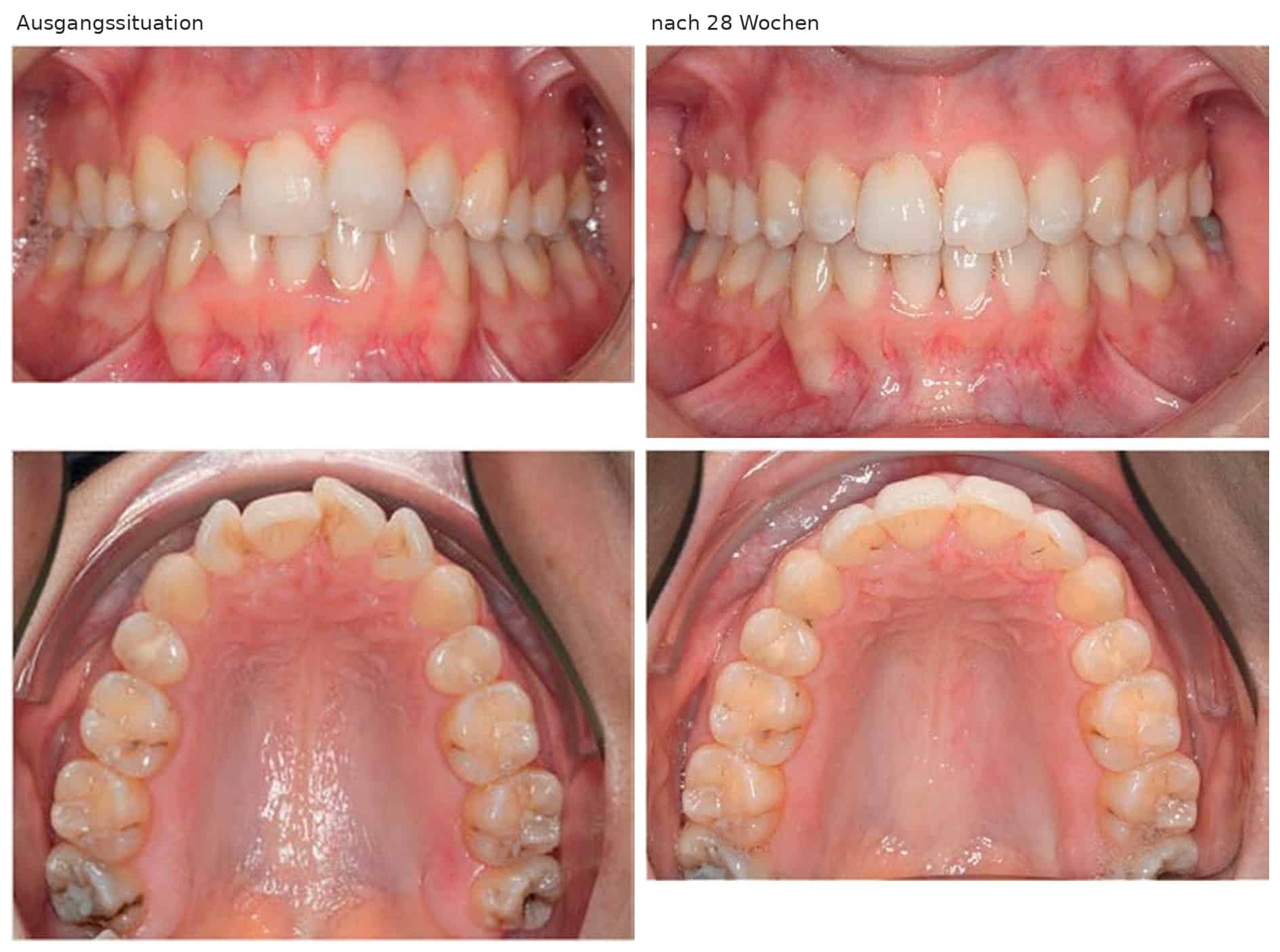
A 36-year-old patient came to us with the wish for a more beautiful, more even smile. Both dental arches were significantly too narrow in width; the teeth were crowded in the upper and lower jaw, and individual teeth were rotated. The molars fit together correctly (Class I occlusion), so correction of the bite was not necessary. As a child, the patient had already undergone orthodontic treatment; during that treatment, the first premolars had been removed. Because the gums were inflamed at the start, we referred her to a periodontist who accompanied her during and after treatment. Visible braces were not an option for her.
Treatment
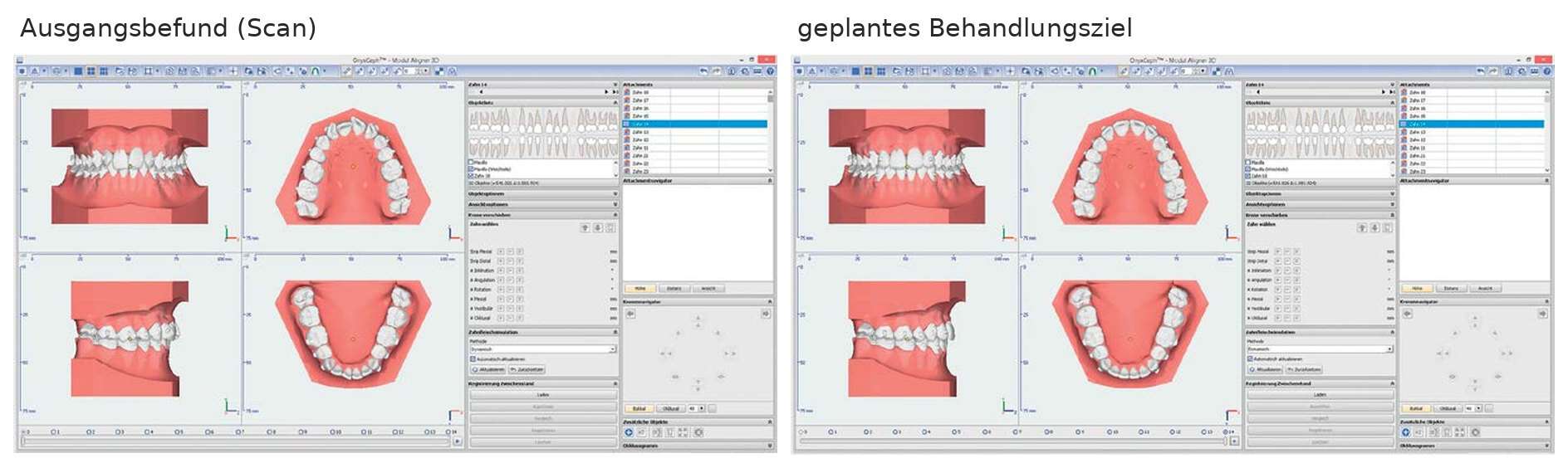
The aligners were planned and fabricated entirely in our practice. The basis was an intraoral scan. From this, the orthodontist defined the treatment goal on the computer and divided the tooth movement into 14 steps; we do not outsource this step to an external service provider. For each step, our laboratory produced two aligners, a thinner one (0.5 mm) and a firmer one (0.75 mm). This way, a gentler force acts on the teeth first, then a stronger one.
The patient changed the aligner every week; with 28 aligners, that resulted in 28 weeks. Small tooth-colored bumps on the teeth (attachments) gave the aligners grip for the planned movements. In a few places, we minimally smoothed the enamel between the teeth to create space. Fine elastics that the patient wore at night and for a few hours during the day improved the interlocking of the teeth.
The Result
After 28 weeks, both dental arches had been expanded in width, the crowding and rotations resolved. The molars continue to interlock in Class I, the upper incisors overlap the lower ones in normal measure. To prevent the teeth from shifting back, the patient wears a thin, clear retainer at night.
What this case shows and what it does not
The 28 weeks represent the duration of this particular treatment. It was possible because the bite position was already correct, sufficient space could be gained through expansion and smoothing, and the patient wore the aligners reliably. If the bite needs to be shifted, if more space is lacking, or if teeth are severely tilted, treatment takes longer; sometimes fixed braces or a combination is more suitable. What applies in your case, we will determine after an examination with a scan.
Aligner treatment is a private service; statutory health insurance does not cover it. You can pay the cost in installments directly through our practice, interest-free for up to 18 months.
Background for Those Interested
How the digital workflow of an in-office aligner treatment works in detail is described in our professional publication The Digital Workflow in In-Office Aligner Therapy. Learn more about treatment with clear aligners on our expertise page.
Sources, studies & further reading
- Schupp, W., Funke, J., & Haubrich, J. (2020). Der digitale Workflow in der In-Office-Alignertherapie. Informationen aus Orthodontie & Kieferorthopädie, 52(4), 289–300. doi:10.1055/a-1241-9967
- Kravitz, N. D., Kusnoto, B., BeGole, E., Obrez, A., & Agran, B. (2009). How well does Invisalign work? A prospective clinical study evaluating the efficacy of tooth movement with Invisalign. American Journal of Orthodontics and Dentofacial Orthopedics, 135(1), 27–35. doi:10.1016/j.ajodo.2007.05.018
- Rossini, G., Parrini, S., Castroflorio, T., Deregibus, A., & Debernardi, C. L. (2015). Efficacy of clear aligners in controlling orthodontic tooth movement: A systematic review. The Angle Orthodontist, 85(5), 881–889. doi:10.2319/061614-436.1
Frequently Asked Questions About Crowding and Aligner Treatment
How long does correction of crowding with aligners take?
In the case presented, the crowding was corrected in roughly seven months. The actual duration depends on the severity of the crowding, compliance in wearing the aligners, and individual anatomical conditions. We will give you an estimate for your case after planning the scan.
Are clear aligners as effective as fixed braces for crowding?
For mild to moderate crowding, modern aligners are a recognized and effective alternative to fixed braces. In cases of very pronounced crowding or complex bite situations, fixed appliances or combination treatment may be more appropriate. What is suitable in each individual case is determined after a thorough diagnosis.
Does a tooth need to be extracted to resolve crowding?
Not necessarily. In many cases, sufficient space can be created through gentle widening of the dental arches without having to remove teeth. Whether extraction is necessary depends on the available space in the jaw and is individually assessed before treatment begins.
Does the result remain stable after treatment?
After correction is complete, stabilization is important to prevent the teeth from shifting back to their original position. A retainer (fixed or removable) is used for this purpose. Teeth can shift slightly throughout life; patients who wear the retainer as instructed and attend check-ups reduce the risk of relapse. Retainers are typically a private service. For children and adolescents receiving statutory health insurance treatment, the insurance may cover retention for up to two years after active treatment. A fixed retainer on the lower front teeth may also be covered by statutory health insurance in cases of severe crowding (KIG E3/E4).
Who is a good candidate for aligner treatment for crowding?
Suitable candidates are primarily adolescents after the change of teeth and adults with mild to moderate crowding who want a discreet treatment; we also use aligners in children in certain situations. The gums should be free of inflammation before starting or treated concurrently, as in the case above. The aligners must be worn about 22 hours a day. Whether aligners are suitable for you, we will clarify in a personal consultation.
Reviewed by Dr. med. dent. Julia Steinmaier, specialist in orthodontics · Last reviewed on June 27, 2026
Related Posts
These blog posts might also interest you.
 May 31, 2026Treatment Example: Gap Closure with Aligners Instead of ImplantRead more →
 Jun 1, 2026Can My Child Already Get Clear Aligners?Read more →
 Aug 20, 2026Treatment Example: Aligner Treatment for a Child – Gentle Instead of Fixed BracesRead more →
Your orthodontist in Cologne!
Schedule your no-obligation consultation at JUST KFO – Dr. Steinmaier & Kollegen in Cologne.
Book online 24/7 in a few clicks · free parking in our courtyard