
Aligners can be planned and fabricated entirely within the practice. This article uses a real case to show the advantages this digital in-office approach offers for treatment.
Digital in-office workflow for aligner therapy from intraoral scanning to fabrication.
Aligners from our own practice: fast, precise and all from one source
Clear aligners have become one of the most popular ways to straighten teeth almost invisibly. Many aligners are manufactured by external providers. In our Cologne practice, however, we can plan and fabricate the aligners entirely in our own laboratory — this is called in-office treatment. The following real treatment case shows what advantages this digital approach offers our patients.
What “in-office” means
In-office means: From the digital scan to treatment planning on the computer to the finished aligner, everything takes place in the practice. Instead of a conventional impression with putty, the dentition is captured contactlessly in 3D using an intraoral scanner.2 On this basis, the orthodontist personally plans every single treatment step and then fabricates the aligners in the in-house laboratory.
The advantage: planning in experienced hands
The most important step – defining the treatment goal and the precise movement sequence of the teeth – is not outsourced to an external service provider or software, but is undertaken personally by the treating orthodontist.1 This way, experience and knowledge of force systems flow directly into the planning. Another advantage: The aligners are quickly available, which is especially practical when treatment needs to be adjusted flexibly.
How an aligner is made in the practice: five steps
The publication divides the in-office pathway into five stages. Some work steps can be undertaken by a dental technician or a trained assistant, but the planning itself remains with the orthodontist.
- Scan and preparation: The intraoral scan is imported into the planning software, aligned, repaired, and virtually based. Then teeth and gums are separated, and the movement axes are defined for each tooth (segmentation).
- Virtual treatment planning: The orthodontist defines the treatment goal (target setup), plans attachments and pressure points, and divides the movement into individual steps (staging). For more complex cases, intermediate goals can be planned.
- 3D printing: A model is printed for each step.6 The model number is placed mirror-reversed on a tooth; it then appears in the aligner, so that each tray is unambiguously identified.
- Thermoforming and finishing: The foil is thermoformed onto the model and trimmed straight about 2 to 3 mm above the gum line, not in a scalloped shape. According to the publication, this improves force transmission without compromising wearing comfort. Finally, the edges are polished.
- Fitting and monitoring: The finished aligners are fitted, and the progress is checked at follow-up appointments.
There are two approaches to staging: either one aligner per step with smaller movements, or several aligners of different thickness per step. In the second approach, the force begins more gently and increases with the thicker foil. In the treatment example below, a case from our practice, this second approach was chosen. The publication also points out that a second phase with refinement aligners is often necessary, similar to the fine-tuning at the end of treatment with fixed braces.
Today we work at JUST KFO with Trios 5 (3Shape), OnyxCeph and Exocad, SHERAprint/Rapidshape 20, 30 and 50, Biostar 4. More about our in-house laboratory.
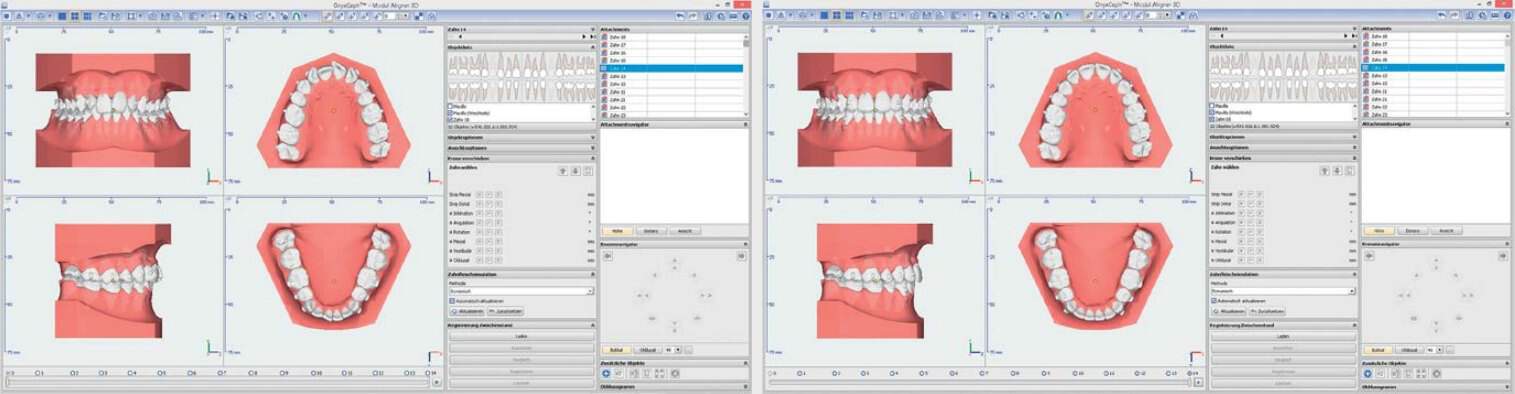
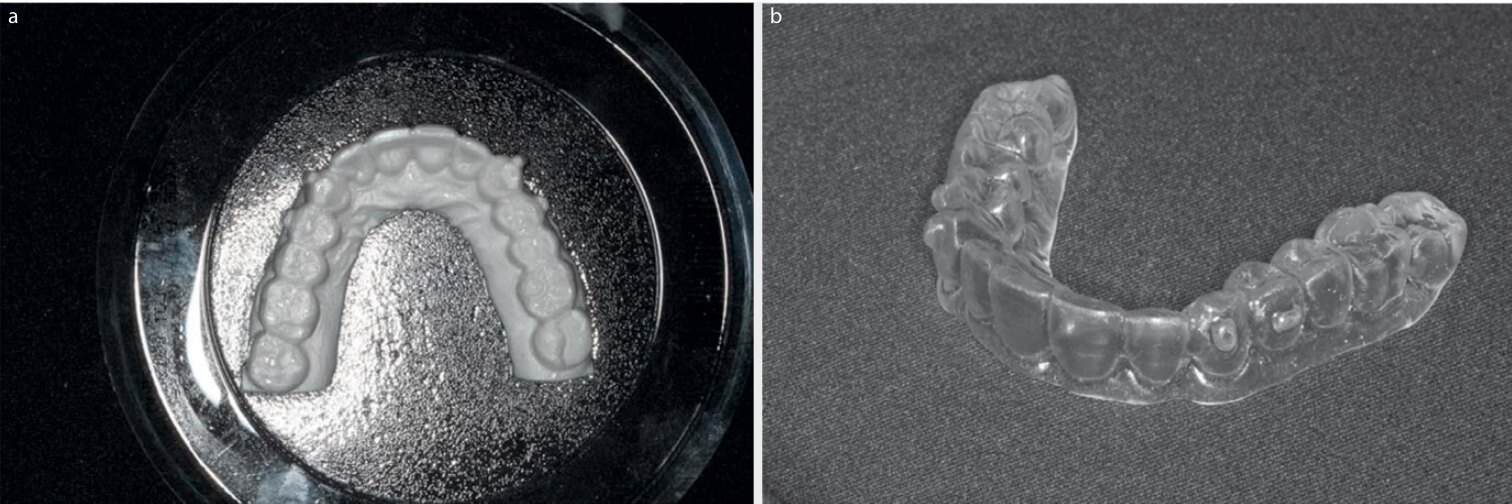
A treatment example
The Initial Situation
A 36-year-old patient came to our practice with the wish for a more beautiful smile. Her dental arches were significantly too narrow in both the upper and lower jaw, and there was crowding as well as slight rotations of individual teeth. She had already received orthodontic treatment during childhood. The bite itself was stable, so the focus was on the harmonious shaping of the dental arches.
The treatment process
After the digital scan, a virtual treatment goal was created on the computer and divided into individual steps. Small, tooth-colored auxiliary elements (attachments)3 on the teeth supported the planned movements, fine elastic bands improved the occlusion. The largest planned movement was a tipping of the upper front teeth by 23.2 degrees. To provide sufficient space for the teeth, the interdental spaces were minimally smoothed in a few places. Fourteen steps were planned; for each step, two aligners were fabricated, first with 0.5 mm and then with 0.75 mm foil thickness. The patient changed the aligners weekly and wore the elastic bands at night and for several hours during the day. Because teeth had been extracted in childhood and the gums were inflamed, she received additional periodontal care throughout the treatment.
The Result
After approximately seven months (28 weeks), the dental arches were harmoniously shaped and the crowding resolved4, with a stable Class I occlusion. To secure the result, the patient wears a 1.5 mm retention appliance at night. How long a treatment takes depends on the initial findings and consistent wear; this case is an example, not a benchmark.
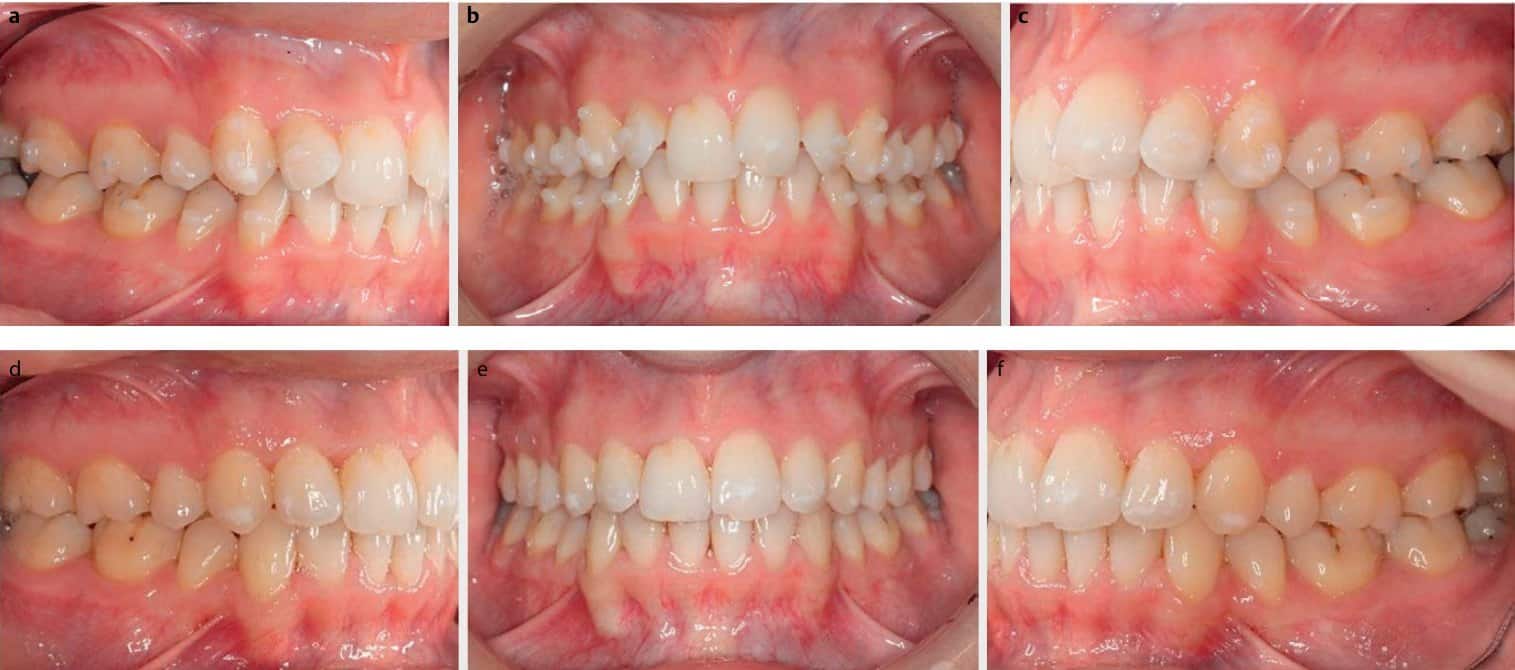
What this case demonstrates
In-office aligner therapy combines the advantages of digital orthodontics with the experience of the treating orthodontist.1 Learn more about treatment with clear aligners on our dedicated page. The key to a good result remains careful planning and consistent wear of the aligners.5 The same case from the patient’s perspective is described in our treatment example for crowding with aligners.
What does this mean for you?
When planning and fabrication take place in the same practice, a new series of aligners can be produced without shipping delays – for example, when adjustments are needed. For you, this means: digital scans instead of impression material, check-up appointments approximately every six to eight weeks, and aligners that you change yourself according to the schedule. Statutory health insurance does not cover aligners; they are a private service. You can pay the costs in installments over up to 18 months, interest-free, directly through the practice. Whether aligners are suitable for your specific tooth alignment will be determined during the consultation appointment; phone 0221 93 53 020.
Sources
- Schupp, W., Funke, J., & Haubrich, J. (2020). Der digitale Workflow in der In-Office-Alignertherapie. Informationen aus Orthodontie & Kieferorthopädie, 52(4), 289–300. https://doi.org/10.1055/a-1241-9967 (J. Funke = Dr. Julia Steinmaier)
- Patzelt, S. B. M., Emmanouilidi, A., Stampf, S., Strub, J. R., & Att, W. (2014). Accuracy of full-arch scans using intraoral scanners. Clinical Oral Investigations, 18(6), 1687–1694. https://doi.org/10.1007/s00784-013-1132-y
- Schupp, W., & Haubrich, J. (Hrsg.). (2015). Aligner Orthodontics. Quintessenz.
- Boyd, R. L., Miller, R. J., & Vlaskalic, V. (2000). The Invisalign System in adult orthodontics: Mild crowding and space closure cases. Journal of Clinical Orthodontics, 34, 203–212.
- Rossini, G., Parrini, S., Castroflorio, T., Deregibus, A., & Debernardi, C. L. (2015). Efficacy of clear aligners in controlling orthodontic tooth movement: A systematic review. The Angle Orthodontist, 85(5), 881–889. https://doi.org/10.2319/061614-436.1
- Cousley, R. R. J. (2022). In-house three-dimensional printing within the digital orthodontic workflow. Journal of the World Federation of Orthodontists, 11(6), 182–189. https://doi.org/10.1016/j.ejwf.2022.10.001
Your orthodontist in Cologne!
Schedule your no-obligation consultation at JUST KFO – Dr. Steinmaier & Kollegen in Cologne.
