Table of contents
Are clear aligners suitable for children? Many parents ask us this question – here is the answer from our practice.
Many parents know clear aligners (aligners) as a treatment for adults. The question we are often asked in our practice is therefore: Is that actually possible for children too? For certain misalignments, yes, even in primary school age, as the example below with an eight-year-old girl shows. For other findings, classic early treatment appliances or later fixed braces are the better choice. You can read which treatments are suitable at which age on our page about orthodontics for children and adolescents in Cologne.

Specialist in orthodontics. Owner of JUST KFO in Cologne, sought-after speaker and author who regularly appears in professional publications and media.
Full profile →Why treat at all during childhood?
Some misaligned teeth and jaw irregularities are best addressed early, while the jaw is still growing. Specialists refer to this as early treatment. A typical example is crossbite, where individual teeth are positioned “the wrong way around” relative to the opposing jaw. When corrected early, further development can often be guided in a good direction.
What speaks in favor of aligners for children?
From a parent’s perspective, clear aligners have a few appealing advantages:
- Barely visible: Many children prefer wearing them over conspicuous fixed braces.
- Removable: The aligners come out for eating and brushing – brushing remains simple, and there are no restrictions on favorite foods.
- Comfortable to wear: No wires or brackets that press or rub.
- No additional bite ramp: To correct a crossbite, the dental arches must be kept apart briefly. With a plate or fixed appliance, bite ramps on the back teeth are needed for this. With aligners, the material thickness of the tray on the chewing surfaces takes over this function.
What matters: compliance
Success depends above all on the trays being worn reliably: around 22 hours a day, removed only for eating and brushing teeth. Here, child and parents are required as a team. Experience shows that this works surprisingly well for many children, especially because they accept the trays as “their” task.
An example from our practice
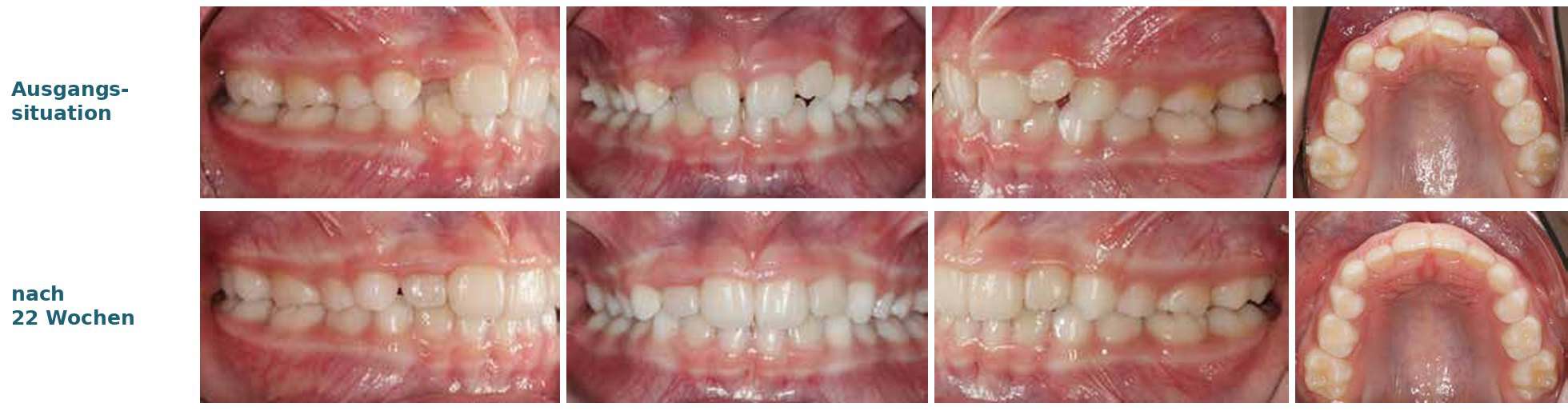
An eight-year-old girl came to us because an upper lateral incisor was biting behind the lower one (crossbite). In addition, the upper jaw was too narrow, and two back molars were rotated. Alternatives included a removable appliance with a spring or a small fixed appliance with bite ramps. We decided on aligners.
After a digital scan, we planned the treatment with planning software in the practice. The incisor was to move forward a total of 4.4 millimeters, divided into eight steps of 0.55 millimeters each. The models for each step were made in a 3D printer, and the trays were fabricated on them in our own laboratory. Small tooth-colored attachments on three teeth ensured that the trays gripped precisely.
The girl wore each tray for one week around 22 hours a day. After 16 trays, 6 more followed for fine-tuning. After 22 weeks, the crossbite was corrected, the upper jaw was widened, and the molars were straight — without a fixed appliance. We have described the professional background in our professional publication on aligner orthodontics in children, the process from a parents’ perspective in the treatment example: aligner treatment for a child.
When aligners are not the right choice for children
Not every misalignment in childhood can be treated with aligners. When the goal is to guide jaw growth, or when the misalignment is very pronounced, other early treatment appliances or later fixed braces are often the safer approach. And if a child does not wear the aligners reliably, a fixed appliance is usually the better solution. We discuss this openly with you and your child before making a decision.
Is my child a candidate?
Whether aligner treatment is suitable for your child depends on the individual situation. This is best clarified in a personal consultation. We would be happy to examine your child’s teeth and advise you on which treatment makes sense.
Sources, studies & further reading
- Schupp, W., Funke, J., & Haubrich, J. (2020). Der digitale Workflow in der In-Office-Alignertherapie. Informationen aus Orthodontie & Kieferorthopädie, 52(4), 289–300. doi:10.1055/a-1241-9967
- Funke, J. (heute Steinmaier), Haubrich, J., & Schupp, W. (2020). Aligner-Orthodontie bei Kindern. Dentista, 01/2020, 16–18.
- Abbate, G. M., Caria, M. P., Montanari, P., Mannu, C., Orrù, G., Caprioglio, A., & Levrini, L. (2015). Periodontal health in teenagers treated with removable aligners and fixed orthodontic appliances. Journal of Orofacial Orthopedics, 76(3), 240–250. doi:10.1007/s00056-015-0285-5
Frequently asked questions about clear aligners for children
From what age are clear aligners suitable for children?
This depends less on age than on the type of misalignment and how far along the tooth transition is. Individual findings such as a crossbite of the front teeth can be treated with aligners even in the early mixed dentition; our patient in the example was eight years old. For other early treatments, removable plates or other appliances are better suited. We determine the right time after an examination.
Are aligners for children as effective as fixed braces?
For many misalignments, aligners are an effective alternative. The prerequisite is cooperation: the aligners work only if they are worn consistently. For complex misalignments, fixed braces may be the better choice.
How long does my child need to wear the aligners?
For good results, the aligners should be worn about 22 hours per day and only removed for eating and brushing teeth. This discipline is the most important requirement for successful treatment.
What happens if my child loses or damages an aligner?
That can happen. It’s important to inform us soon — usually, the previous aligner is then worn for a bit longer, or the current one is refabricated to prevent the teeth from shifting back.
Does health insurance cover treatment for children?
If treatment is medically necessary, cost coverage is determined by the orthodontic indication groups (KIG). For KIG 3 to 5, the following applies: Statutory health insurance pays 80 percent of the costs directly; the 20 percent co-payment is reimbursed after successful completion of treatment. However, aligners are not part of the statutory health insurance benefit catalog; clear aligners are always a private service. For children and adolescents with KIG 3 to 5, standard care with fixed braces remains the statutory benefit. If the family chooses aligners instead, the treatment is a private service — the insurance does not contribute. We present the costs to you in advance; if desired, you can pay in installments of up to 18 months interest-free directly through our practice.
How often do we need to come to the practice during treatment?
Your child changes the aligners at home. For follow-up appointments, we see you approximately every six to eight weeks. You can book the initial consultation online or by calling 0221 93 53 020; afterward, you will receive a link to our digital medical history form “Nelly” via text or email.
Reviewed by Dr. med. dent. Julia Steinmaier, specialist in orthodontics · Last reviewed on June 27, 2026
Related Posts
These blog posts might also interest you.
 Aug 20, 2026Treatment Example: Aligner Treatment for a Child – Gentle Instead of Fixed BracesRead more →
 Mar 16, 2025Invisalign and Aligners: Advantages and Disadvantages at a GlanceRead more →
 Jun 1, 2026Impacted canine – can it be treated without fixed braces?Read more →
Your orthodontist in Cologne!
Schedule your no-obligation consultation at JUST KFO – Dr. Steinmaier & Kollegen in Cologne.
Book online 24/7 in a few clicks · free parking in our courtyard