Note: The following treatment course describes a real patient case treated in our practice. Every treatment is individual; the results shown cannot be transferred one-to-one to other cases.
When the canine does not erupt on its own
The upper canine has the longest and most complicated path of all teeth before it reaches its place in the dental arch. If it becomes stuck along this path, it is called an impacted canine. This affects about 1 to 3 in 100 people, girls approximately twice as often as boys. Most commonly, the tooth is positioned on the palatal side. Many parents then ask us whether their child needs fixed braces for this.
The following treatment example from our Cologne practice shows that the visible treatment can largely be achieved with clear aligners – even in a challenging case.
The Initial Situation
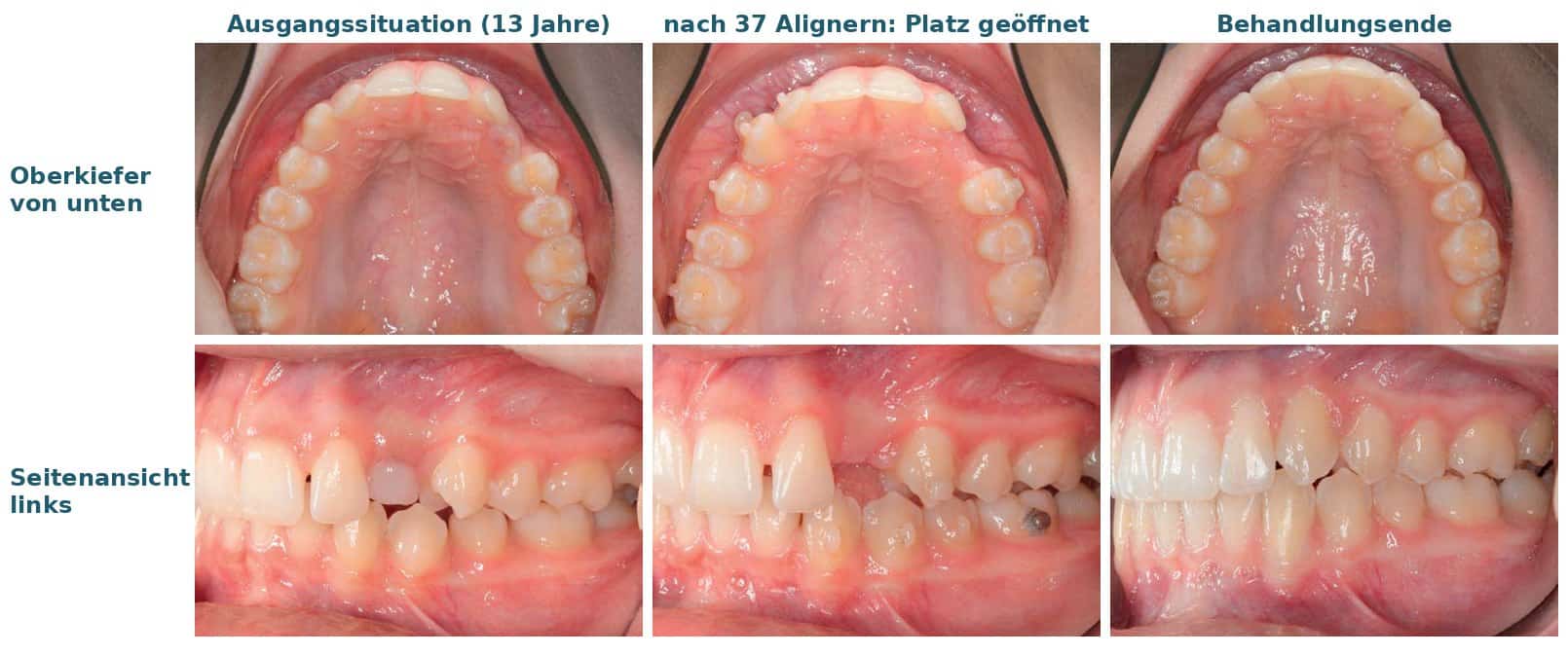
A 13-year-old patient came to us because a canine in the upper jaw had not erupted. In its place, the baby tooth was still present, and there was no space for the permanent canine to move into the arch. Additionally, there were slight rotations and tilts as well as a deep bite. She had been referred by her family dentist; she herself had mainly noticed that the lateral incisor next to it was crooked. The X-ray showed the permanent canine impacted in the jaw; the temporomandibular joints and the other bone structures were unremarkable.
Why you should not simply wait
A permanently impacted canine can press on the roots of neighboring teeth and damage them. Therefore, it makes sense to act in time and actively create a path for the tooth into the dental arch.
If impaction is detected early, sometimes a small step is enough: the primary canine is extracted so that the permanent tooth can find its way. In a Swedish study, 78 out of 100 palatally impacted canines erupted normally afterward (Ericson & Kurol 1988). Prerequisites are sufficient space and healthy roots of the neighboring teeth. Signs of impaction can be detected on X-rays from about 9 years of age; from about 10 years, the canine can normally be palpated from the outside on the jaw. Our patient came at 13 years of age, and space was lacking. Therefore, a longer approach was necessary.
The treatment process
Creating space with clear aligners
First, the remaining primary tooth was removed to create space. We then shaped the dental arches with the aligner system and carefully moved the lateral teeth in the upper jaw backward. This was supported by elastics between the upper and lower jaws. For this first phase, 64 aligners were planned, changed weekly. After 37 aligners, the space was open enough.
Bringing the canine into the arch
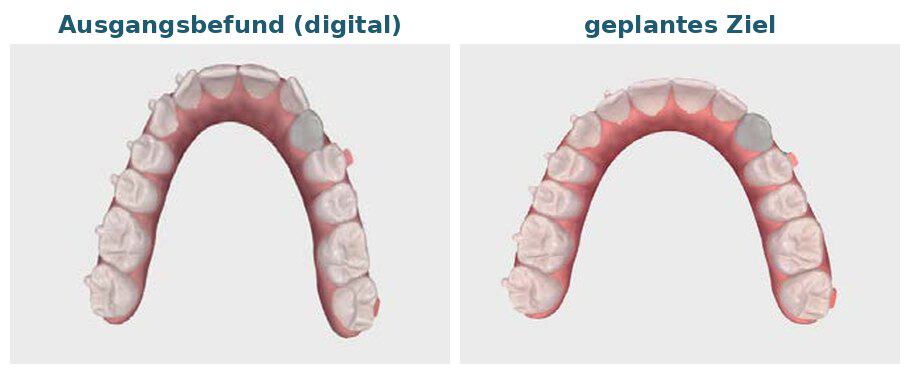
The canine still did not erupt on its own. It was therefore exposed in a minor surgical procedure and fitted with a small chain. For this phase, we bonded a small sectional arch to three posterior teeth, which pulled the canine into the oral cavity. During this time, the patient continued to wear the aligners at night to maintain what had been achieved so far. This intermediate step took only a limited amount of time; the actual tooth alignment continued with the aligners.
After that, the patient took a ten-month break due to a stay abroad. After her return, a new scan was taken, and 38 additional aligners completed the shaping of the dental arches. Small bite ramps behind the upper front teeth, which were incorporated into the aligners, helped to correct the deep bite.
The Result
In the end, the previously impacted canine was fully positioned in the dental arch, the bite was harmonious, and the midline was aligned. To maintain the result, the patient wears a retainer in the upper jaw at night and a fixed bonded retainer behind the lower front teeth, invisible from the outside.
In total, the patient wore 75 aligners, meaning 75 weeks of active aligner treatment. From the initial consultation to completion, three years passed, including the surgical exposure and the ten-month break.
What this example shows
In this patient’s case, the impacted canine could be aligned primarily with clear aligners. A small sectional arch bonded to three posterior teeth was only necessary for one phase. Whether this approach will work for another child depends on the position of the tooth; if it is positioned very unfavorably, fixed braces are often the safer route. In any case, precise planning and reliable wear of the aligners are essential.
Detailed clinical background on this case can be found in our related professional publication. More about treatment with clear aligners can be read on our page about Invisalign.
- Funke, J., Schupp, W., Haubrich, J., & Jung, B. A. (2020). Einstellung eines palatinal verlagerten Eckzahns mittels Alignertherapie – ein Fallbericht. Informationen aus Orthodontie & Kieferorthopädie, 52(4), 259–265. https://doi.org/10.1055/a-1242-0044
- Ericson, S., & Kurol, J. (1988). Early treatment of palatally erupting maxillary canines by extraction of the primary canines. European Journal of Orthodontics, 10(4), 283–295. https://doi.org/10.1093/ejo/10.4.283
- Bishara, S. E. (1992). Impacted maxillary canines: A review. American Journal of Orthodontics and Dentofacial Orthopedics, 101(2), 159–171. https://doi.org/10.1016/0889-5406(92)70008-X
- Schupp, W., Funke, J., & Haubrich, J. (2020). Der digitale Workflow in der In-Office-Alignertherapie. Informationen aus Orthodontie & Kieferorthopädie, 52(4), 289–300. https://doi.org/10.1055/a-1241-9967
Frequently Asked Questions About Impacted Canines
What is an impacted canine?
An impacted (retained) canine is a canine tooth that does not erupt in its normal position but remains in the jawbone or grows in the wrong direction. Upper canines are particularly often affected.
Can an impacted canine be treated without fixed braces?
That depends on the position and severity. In certain cases, treatment with clear aligners combined with additional aids is possible. However, severely impacted canines often require a fixed appliance to guide the tooth into position in a controlled manner. What is possible in individual cases is determined by diagnostics.
How does treatment of an impacted canine work?
First, the exact position is determined – usually by 3D X-ray. Often, a minor surgical procedure exposes the tooth, and then it is slowly moved orthodontically to its correct position. How long this takes depends on the position of the tooth and the available space in the jaw; in our example, it took three years, including a ten-month break.
At what age should an impacted canine be treated?
The earlier an impaction is detected, the simpler the treatment. Monitoring the development of the canines at around 9 to 11 years of age is advisable. At this age, a malposition can often already be identified, and extracting the primary canine can still clear the way for the permanent tooth.
What happens if an impacted canine remains untreated?
Left untreated, an impacted canine can damage adjacent tooth roots, form cysts, or lead to gaps and misalignments. Early evaluation helps avoid such consequences.
Does health insurance cover the treatment of an impacted canine?
For children and adolescents under 18, an impacted permanent tooth is one of the findings for which statutory health insurance may cover treatment: In the orthodontic indication groups (KIG), impaction is classified as level 5, eruption disturbance as level 4 – wisdom teeth excluded. Statutory health insurance pays 80 percent of the costs directly; the 20 percent patient contribution is reimbursed after successful completion of treatment. Statutory insurance does not cover aligners; clear aligners are always a private service. For children and adolescents with KIG 3 to 5, standard care with fixed braces remains the covered benefit; if the family chooses aligners instead, treatment becomes a private service – statutory insurance does not contribute. We explain the costs in advance; if you wish, you can pay in installments up to 18 months interest-free directly through our practice.

Dr. Julia Steinmaier
Specialist in orthodontics. Owner of JUST KFO in Cologne, sought-after speaker and author who regularly appears in professional publications and media.
Full profile →Related Posts
These blog posts might also interest you.
 Jun 1, 2026Can My Child Already Get Clear Aligners?Read more →
 Jun 1, 2026Treatment Example: Crowding Corrected with Aligners – This Case Took 7 MonthsRead more →
 Aug 20, 2026Treatment Example: Complex Correction in Adults – Aligners with Mini-AnchorageRead more →
Reviewed by Dr. med. dent. Julia Steinmaier, specialist in orthodontics · Last reviewed on June 5, 2026
Your orthodontist in Cologne!
Schedule your no-obligation consultation at JUST KFO – Dr. Steinmaier & Kollegen in Cologne.