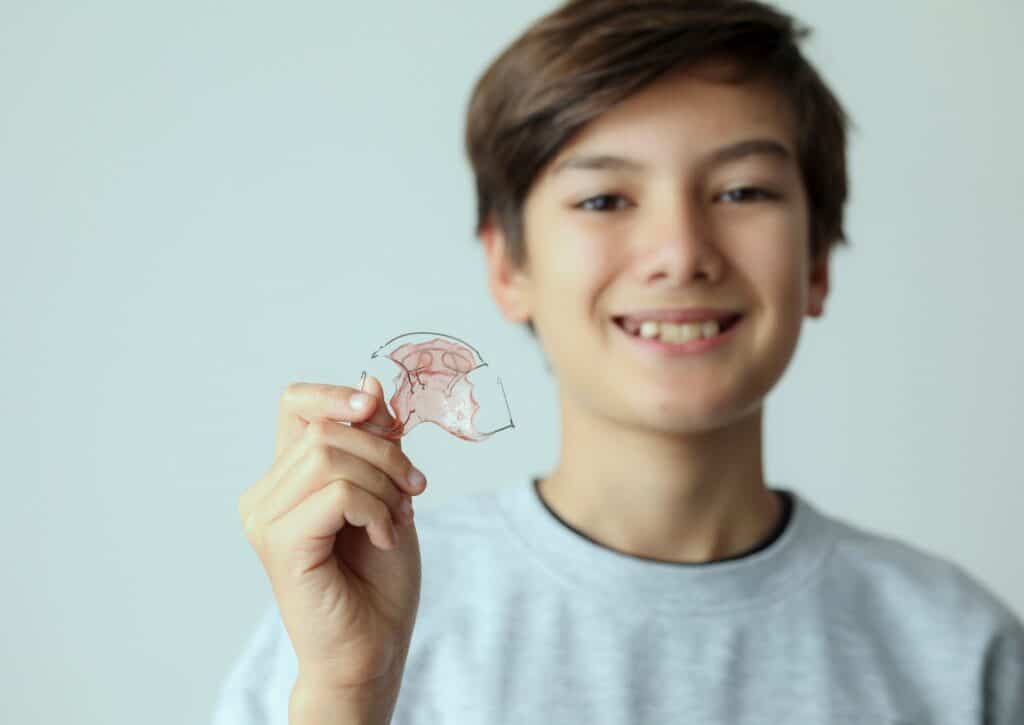
Not every child needs braces. However, whether and when treatment makes sense can be recognized early. One of the most common questions parents ask is when they should bring their child to the orthodontist. Learn more about treatment for children and adolescents and about when braces make sense. In this article, you will learn when the first examination is advisable and in which cases early treatment can offer advantages.
The different phases of orthodontic treatment for children
Orthodontic treatments can be divided into different phases, depending on the child’s age and the type of dental or jaw misalignment:
- Early treatment: It is only necessary for specific conditions and typically takes place between ages 4 and 9, while the child is still growing. In these cases, it can help prevent more serious problems later in life and make subsequent treatment less complex.
- Late mixed dentition phase: This phase occurs when both permanent and primary teeth are present, usually between ages 9 and 14. This phase is ideal for creating space for the permanent teeth and promoting healthy jaw growth.
- Permanent dentition: This phase begins when all permanent teeth have erupted, typically between ages 12 and 16. During this phase, aligners or fixed braces are used to correct the final position of the teeth and jaw.
We consider the first visit between ages 6 and 9 to be the practical time. The German Society for Orthodontics, in its statement “Recommended Times for Orthodontic Examinations,” suggests staggered appointments: an examination after all primary teeth have erupted, then during the first mixed dentition phase (around ages 6 to 8) and during the second (around ages 9 to 12). An early examination is advisable because misaligned teeth and jaws can be identified in time; early treatment is only provided for specific conditions. This may sound early – but it helps assess tooth eruption, jaw growth, and the development of the permanent dentition. What actually happens during these appointments is explained in our article Examinations Before Braces.
These signs suggest an earlier appointment
Regardless of age, you should bring your child in if you notice any of these signs:
- One or more upper teeth bite behind the lower teeth (crossbite), at the front or on the side.
- The lower incisors protrude in front of the upper ones.
- The upper incisors protrude significantly; they break more easily during falls.
- The front teeth do not meet when biting down (open bite), often after prolonged thumb sucking or pacifier use.
- Your child breathes persistently through the mouth or snores.
- Primary teeth are lost early due to decay or injury.
- A permanent tooth erupts months later than its counterpart on the other side, or a primary canine is still firmly in place at age 11 to 12.

When is early treatment beneficial?
For certain conditions, early treatment can offer advantages:
- Early detection of problems: Orthodontists can identify potential dental and jaw misalignments early and intervene accordingly.
- Corrections during growth: Some conditions, such as a crossbite or a narrow upper jaw, can be treated more easily with simple appliances during growth than later.
- Fewer space problems: If a baby tooth is lost too early, early treatment can preserve the space for the permanent tooth and thus reduce the risk of later tooth extractions.
- Appearance: For clearly visible misalignments, such as severely protruding front teeth, correction can improve appearance and strengthen the child’s self-confidence.
- Protection against subsequent damage: Severely protruding front teeth are more prone to breaking off during falls; a crossbite in which the lower jaw shifts to the side can guide jaw growth asymmetrically.
For most children, treatment, if any, begins only in the late mixed dentition. Early monitoring serves primarily to identify the children for whom waiting would have disadvantages.
Two examples from our practice
At age 8: A girl came to us with a crossbite on an upper front tooth, a narrow upper jaw, and two rotated molars. We planned the correction on the computer and fabricated the aligners in our in-house laboratory. With 22 clear aligners, each worn for one week, the crossbite was corrected after 22 weeks. The entire process is shown in our treatment example: aligner treatment in a child.
At age 13: In a teenage girl, an upper canine was impacted in the jaw, and the baby canine was still present. If such an impaction is detected at age 9 to 11, sometimes extracting the baby canine alone is sufficient for the permanent tooth to erupt on its own (Ericson & Kurol 1988). In this case, space creation with aligners, a minor exposure, and a total of three years of treatment including a pause were necessary. More on this in the article Impacted canine – is it possible without fixed braces?
What does health insurance cover?
For children with statutory health insurance, the orthodontic examination is covered. Whether insurance will cover treatment depends on the orthodontic indication groups (KIG). If KIG 3, 4, or 5 is present, statutory health insurance pays 80 percent of the costs directly; the 20 percent co-payment is refunded after successful completion of treatment. Early treatment is the exception, not the rule. It may be considered for a crossbite, for protruding front teeth with increased risk of injury, for a pronounced open bite, for a reverse overbite, for space loss after premature loss of a baby tooth, and for sucking habits or mouth breathing that shape the jaw. Whether statutory health insurance pays is determined by the KIG classification at the initial examination. Whether statutory or privately insured: diagnostics, consultation, and care are the same for all our patients.
After booking the initial consultation, you will receive a link via text message or email to our digital health questionnaire “Nelly,” where you can enter information about your child in advance.
Our recommendation for parents
When should you take your child to an orthodontist?
The answer to this question varies depending on individual circumstances and the type of dental or jaw misalignment. Generally, however, orthodontists recommend that children receive an initial examination between the ages of 6 and 9 to detect and treat potential problems early. What distinguishes a specialist in orthodontics from other titles is explained in our article What Is an Orthodontist?
Come in for the first checkup when your child is about 6 to 9 years old, or earlier if any of the signs mentioned above are present. Often the result of this first examination is that nothing needs to be done yet; in that case, we typically see your child again after one year and monitor the tooth transition.
Sources:
- Fleming P. S. (2017). Timing orthodontic treatment: early or late?. Australian dental journal, 62 Suppl 1, 11-19. https://doi.org/10.1111/adj.12474
- Pisani, L., Bonaccorso, L., Fastuca, R., Spena, R., Lombardo, L., & Caprioglio, A. (2016). Systematic review for orthodontic and orthopedic treatments for anterior open bite in the mixed dentition. Progress in orthodontics, 17(1), 28. https://doi.org/10.1186/s40510-016-0142-0
- Brierley, C. A., DiBiase, A., & Sandler, P. J. (2017). Early Class II treatment. Australian dental journal, 62 Suppl 1, 4-10. https://doi.org/10.1111/adj.12478
- Hamidaddin M. A. (2023). Optimal Treatment Timing in Orthodontics: A Scoping Review. European journal of dentistry, 10.1055/s-0043-1768974. Advance online publication. https://doi.org/10.1055/s-0043-1768974
- Woon, S. C., & Thiruvenkatachari, B. (2017). Early orthodontic treatment for Class III malocclusion: A systematic review and meta-analysis. American journal of orthodontics and dentofacial orthopedics : official publication of the American Association of Orthodontists, its constituent societies, and the American Board of Orthodontics, 151(1), 28-52. https://doi.org/10.1016/j.ajodo.2016.07.017
- Shalish, M., Gal, A., Brin, I., Zini, A., & Ben-Bassat, Y. (2013). Prevalence of dental features that indicate a need for early orthodontic treatment. European journal of orthodontics, 35(4), 454-459. https://doi.org/10.1093/ejo/cjs011
- Graber L. W. Vanarsdall R. L. Vig K. W. L. & Huang G. J. (2017). Orthodontics : current principles and techniques (Sixth). Elsevier.
- American Association of Orthodontists (AAO). (2021). “When Should Your Child See an Orthodontist?”. Verfügbar unter: https://aaoinfo.org/whats-trending/when-should-your-child-see-an-orthodontist/
- Deutsche Gesellschaft für Kieferorthopädie (DGKFO): Stellungnahme „Empfehlenswerte Zeitpunkte kieferorthopädischer Untersuchungen“, Stand März 2007 (DGKFO-Archiv, dgkfo-vorstand.de).
- Deutsche Gesellschaft für Kieferorthopädie (DGKFO) & Deutsche Gesellschaft für Zahn-, Mund- und Kieferheilkunde (DGZMK): S2k-Leitlinie Ideale Zeitpunkte und Maßnahmen der kieferorthopädischen Diagnostik. AWMF-Registernr. 083-050, Version 1.1 (Juni 2025, gültig bis 01.06.2030). register.awmf.org/de/leitlinien/detail/083-050
- Ericson, S., & Kurol, J. (1988). Early treatment of palatally erupting maxillary canines by extraction of the primary canines. European Journal of Orthodontics, 10(4), 283–295. https://doi.org/10.1093/ejo/10.4.283
- Funke, J. (heute Steinmaier), Haubrich, J., & Schupp, W. (2020). Aligner-Orthodontie bei Kindern. Dentista, 01/2020, 16–18.
Frequently Asked Questions About When to See an Orthodontist
At what age should my child see an orthodontist?
For most children, an initial visit between the ages of 6 and 9 is appropriate. This allows us to identify early on whether and when treatment is necessary. In cases of noticeable findings such as a crossbite or pronounced mouth breathing, an earlier appointment may be advisable.
What is early treatment and when is it necessary?
Early treatment typically takes place between the ages of about 4 and 9, while the jaw is still growing. It is used only for certain findings, such as the signs mentioned above, and can help avoid more extensive corrections later on.
Do I need a referral to see an orthodontist?
No. In Germany, you have free choice of physician—you can book an appointment directly at an orthodontic practice. However, dentists often point out when the time is right.
What happens at the first appointment?
The teeth, jaw, and bite are examined, often supplemented by a 3D scan instead of an impression. Based on this, we discuss whether treatment is needed and when the best time would be—without pressure and at your own pace.
Is it a problem if we miss the ideal timing?
Usually not. Many misalignments can still be treated well later. However, for some growth-dependent findings, a certain time window is more favorable—which is why early checkups are worthwhile.
How often does my child need to come in for checkups if no treatment is needed yet?
We schedule the next appointment based on the findings, typically after one year, so we can monitor the tooth transition and not miss the right time to begin treatment.

Dr. Julia Steinmaier
Specialist in orthodontics. Owner of JUST KFO in Cologne, sought-after speaker and author who regularly appears in professional publications and media.
Full profile →Related Posts
These blog posts might also interest you.
 Apr 16, 2020Does My Child Need Braces?Read more →Dec 15, 2024When Do Braces Make Sense? Tips and Guidance from ExpertsRead more →Nov 25, 2025Misaligned Teeth: Causes and PreventionRead more →
Reviewed by Dr. med. dent. Julia Steinmaier, specialist in orthodontics · Last reviewed on June 11, 2026
Your orthodontist in Cologne!
Schedule your no-obligation consultation at JUST KFO – Dr. Steinmaier & Kollegen in Cologne.