Even more complex malocclusions can be treated with aligners when combined with small skeletal anchorage implants. This case report demonstrates this approach for an anterior open bite with space closure.
Complex aligner cases (anterior open bite, extraction) with skeletal anchorage.
Approaching complex orthodontic treatment cases using aligners in combination with skeletal anchorage
Some orthodontic starting situations are particularly challenging — for instance, when multiple misalignments occur simultaneously and a tooth must be replaced or a gap closed. The following real treatment case from our Cologne practice demonstrates how even such a complex case can be resolved using clear aligners when combined with stable anchorage in the palate.
The Initial Situation
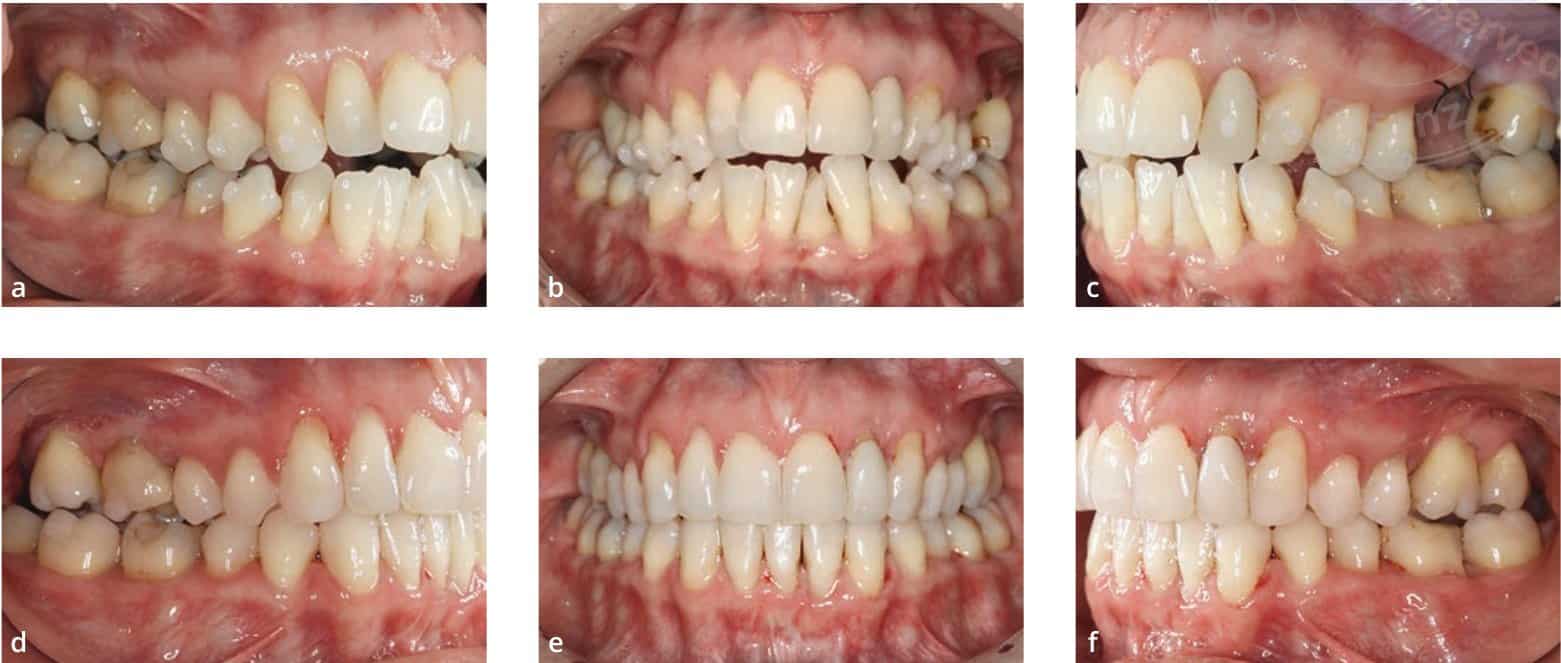
A 48-year-old patient needed to have her upper left first molar (first molar) removed. Instead of replacing the resulting gap with an implant, she wanted the most inconspicuous orthodontic solution possible.1 In addition, there were several other findings: severe crowding in the lower jaw, an open bite in the front tooth area, and a unilateral crossbite. The gums were thin and had already receded on several teeth. Such a combination requires particularly careful, three-dimensional planning.
The treatment approach
Gap closure instead of implant
Instead of filling the gap artificially, the posterior teeth were moved forward in a controlled manner to close it naturally. Such movement of large teeth over a long distance is only possible with very stable anchorage — provided by a palatal system with small mini-implants.2
The appliance, a so-called mesial slider, was designed on the computer using the digital model and fabricated from metal. It is held by three mini-implants in the anterior palate (two measuring 2 × 9 mm, one measuring 2 × 7 mm). A nickel-titanium spring with approximately 200 g of traction force pulled the second and third molars on the left forward step by step. Because the force is supported directly on the mini-implants, the remaining teeth remain unloaded. The appliance and mini-implants were placed in collaboration with Prof. Dr. Benedict Wilmes at the University of Düsseldorf; the aligner treatment was carried out in parallel at our practice.
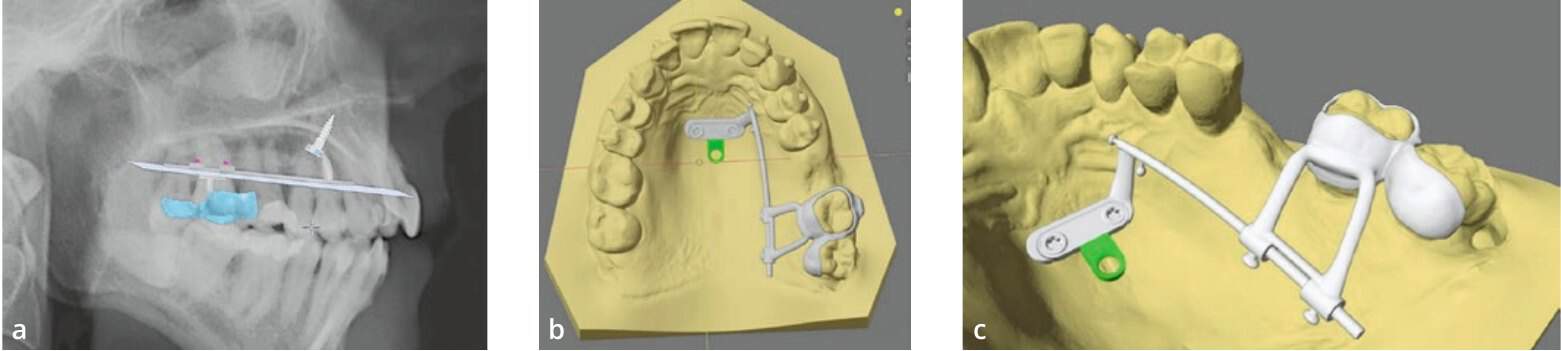
You can read in detail about how this technique is used for a classic gap closure in the posterior tooth area on our page about the mesial slider in the posterior dentition.
Aligners for overall correction
The actual tooth alignment was carried out using clear aligners. They provided nearly invisible treatment and controlled tooth movements precisely.3 To resolve the severe crowding in the lower jaw, a single lower incisor was additionally removed.4 The reason: if the space had been created by widening the dental arch, the thin gums would have come under further pressure. The decision for such an extraction is weighed on a case-by-case basis because a small triangle without gum tissue can form between the incisors. Learn more about treatment with clear aligners on our specialized page.
Progress in Numbers
- Check-up appointments approximately every ten weeks.
- After 20 weeks, the molars had moved forward about 1 mm, after 28 weeks about 3 mm, after approximately one year about 5 mm. Overall, they were moved about 10 mm.
- Because the aligners were temporarily not worn long enough, they no longer fit precisely. Several rescans and additional aligner series were necessary, totaling 90 aligners.
- Total duration: approximately 2.5 years.
The authors openly name two observations. With large tooth movements using firmly anchored mechanics, visibly little happens during the first two to three months before the movement sets in. And in retrospect, it would have been more favorable to extract the molar shortly before inserting the mesial slider, because the bone permits tooth movements more readily immediately after an extraction.

The treatment result
At the end, the gap of the extracted molar was completely closed, the open bite corrected5 and the teeth brought into harmonious, functional occlusion. An implant was not necessary; the mesial slider was positioned on the palate and was not visible from the outside. To secure the result, the patient wears a fixed retainer behind the lower front teeth and canines and wears an aligner in the upper jaw at night. An X-ray five months after completion showed stable bone conditions around the moved molars.
What this case demonstrates
Even complex initial situations with multiple simultaneous malocclusions can be treated today with clear aligners, provided they are combined with suitable skeletal anchorage. Such treatments take longer and require more appointments than a simple aligner correction; whether they are an option for you will be clarified during the consultation. In any case, precise planning and good cooperation from the patient remain important. How this case progressed from the patient’s perspective can be read in our treatment example: Complex correction in adults.
Sources
- Re, S., Cardaropoli, D., Corrente, G., & Abundo, R. (2001). Bodily tooth movement through the maxillary sinus with implant anchorage for single tooth replacement. Clinical Orthodontics and Research, 4(3), 177–181. doi:10.1034/j.1600-0544.2001.040308.x
- Wilmes, B., Nienkemper, M., Nanda, R., Lübberink, G., & Drescher, D. (2013). Palatally anchored maxillary molar mesialization using the mesialslider. Journal of Clinical Orthodontics, 47(3), 172–179.
- Rossini, G., Parrini, S., Castroflorio, T., Deregibus, A., & Debernardi, C. L. (2015). Efficacy of clear aligners in controlling orthodontic tooth movement: A systematic review. The Angle Orthodontist, 85(5), 881–889. doi:10.2319/061614-436.1
- Palikaraki, G., Karamesinis, K., & Damanakis, G. (2018). Orthodontic treatment in a periodontal patient with incisor extraction using the Invisalign clear aligner system: A case report. Journal of Aligner Orthodontics, 2(4), 317–323.
- Dayan, W., Aliaga-Del Castillo, A., & Janson, G. (2019). Open-bite treatment with aligners and selective posterior intrusion. Journal of Clinical Orthodontics, 53, 53–54.
Your orthodontist in Cologne!
Schedule your no-obligation consultation at JUST KFO – Dr. Steinmaier & Kollegen in Cologne.
Book online 24/7 in a few clicks · free parking in our courtyard