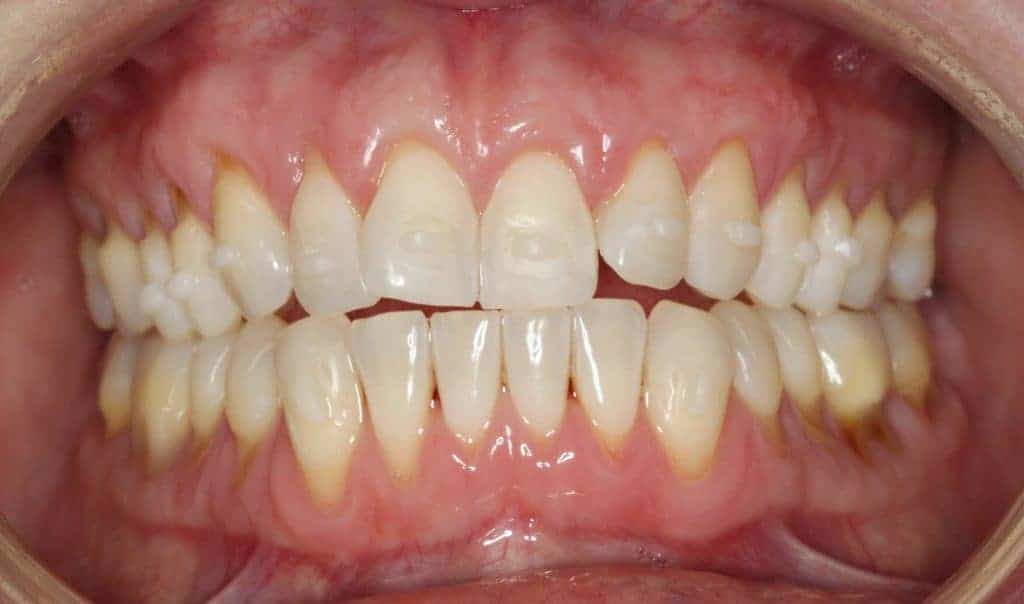
An open bite is one of the more complex misaligned teeth and jaw misalignments and can affect both children and adults. It is characterized by the upper and lower teeth not fully meeting when biting down, leaving a gap between the rows of teeth. This can not only affect appearance but also impair functions such as chewing, speaking, or breathing.
At our orthodontic practice , we provide comprehensive information about the main causes of an open bite, possible consequences, and individually suitable treatment options.
What is an open bite? – Definition
In an open bite, there is a visible gap between the upper and lower rows of teeth in the front or back tooth area, even when the mouth is closed. We distinguish between:
-
Anterior open bite: gap in the front tooth area
-
Posterior open bite: gap in the back tooth area
The severity can vary greatly – from mild forms to significant functional limitations.
Causes of an open bite
An open bite usually develops through the interaction of several factors. Common causes include:
-
Childhood habits (e.g., thumb sucking, prolonged pacifier use)
-
Tongue dysfunction, such as persistent tongue thrusting
-
Mouth breathing instead of nasal breathing
-
Genetic predisposition and jaw growth disorders
-
Developmental issues during tooth transition
The earlier the cause is identified, the more straightforward a targeted treatment can be.
What effects can an open bite have?
An untreated open bite can cause various long-term problems, including:
-
Chewing difficulties and limitations when biting food
-
Speech disorders, such as lisping or impaired pronunciation
-
Often accompanying: mouth breathing, open mouth at rest, snoring. Here the direction is usually reversed: obstructed nasal breathing and a low tongue position promote the open bite, not the other way around. Snoring with pauses in breathing therefore belongs first in an ENT or pediatric practice.
-
Difficulty closing the lips
-
Overload of individual teeth with increased risk of tooth wear
-
Temporomandibular joint problems (TMD) and jaw pain
-
Visual impairment of the facial profile
Early orthodontic evaluation is therefore advisable – regardless of age.
How is an open bite diagnosed?
In our practice, diagnosis is based on a comprehensive examination:
-
Clinical analysis of tooth rows, tooth position, and bite alignment
-
Digital impression using 3D scan
-
Functional diagnostics of breathing, tongue, lips, and temporomandibular joints
-
Supplementary X-ray diagnostics when needed
This allows us to precisely determine the causes and plan individually appropriate therapy.
After booking your initial consultation appointment, you will receive a link via text message or email to our digital medical history form “Nelly”. This way, pre-existing conditions and habits such as thumb sucking or snoring are already available before the appointment, and the time in the practice belongs to the examination and your questions.
Treatment options for open bite
Treatment depends on age, cause, and severity of the misalignment.
Treatment in childhood and adolescence
For young patients, growth-guiding measures are often the focus:
-
Breaking harmful habits (thumb, pacifier)
-
Functional orthodontic appliances
-
Early correction of tongue and breathing patterns
For the choice of treatment, what matters most is whether the permanent front teeth are already present. If a child stops thumb sucking or using a pacifier while the baby teeth are still in front, an anterior open bite often closes on its own. If the habit continues into the tooth change phase, the permanent front teeth grow into the gap, and the tongue becomes accustomed to pressing forward into the space when swallowing. Then stopping the habit alone is usually no longer enough. In our practice, at this stage we use a vestibular screen or – to guide growth between the ages of 6 and 14 – functional orthodontic appliances such as the Fränkel function regulator, the Balters bionator, active plates, or an activator, in cases of pronounced tongue dysfunction together with myofunctional therapy in a speech therapy practice.
Treatment in Adults
Even in adulthood, successful treatment is possible, for example through:
-
Fixed braces for precise correction of the dental arches
-
Aligner therapy in suitable cases
-
Combination with functional therapy (e.g., speech therapy to improve pronunciation)
-
In rare cases: surgery to correct skeletal misalignments
At our orthodontic practice, we provide comprehensive consultation on which method is medically appropriate.
Treatment example: open bite, crowding, and missing molar
How complex an open bite can be in adults is shown by a case we treated in our practice and which Dr. Julia Steinmaier (née Funke) published together with colleagues in the Journal of Aligner Orthodontics. The adult patient had an open bite in the front tooth area, a narrow upper jaw, significant crowding of the lower front teeth, and a large gap: the first upper left molar had to be removed shortly before. Instead of an implant, she wanted to close the gap orthodontically.
For this, the posterior molars were moved forward into the gap using a fixed auxiliary appliance (mesial slider) anchored to two mini-implants in the palate. At the same time, aligners straightened the dental arches and closed the open bite. In the lower jaw, one front tooth was removed to resolve the crowding without further forward tipping of the front. A total of 90 aligners and around two and a half years of treatment were necessary. The authors write openly that several additional phases became necessary because the aligners were worn for too short a time at times. Since the end of treatment, a fixed retainer holds the lower front, and the patient wears a retainer at night on the upper arch.
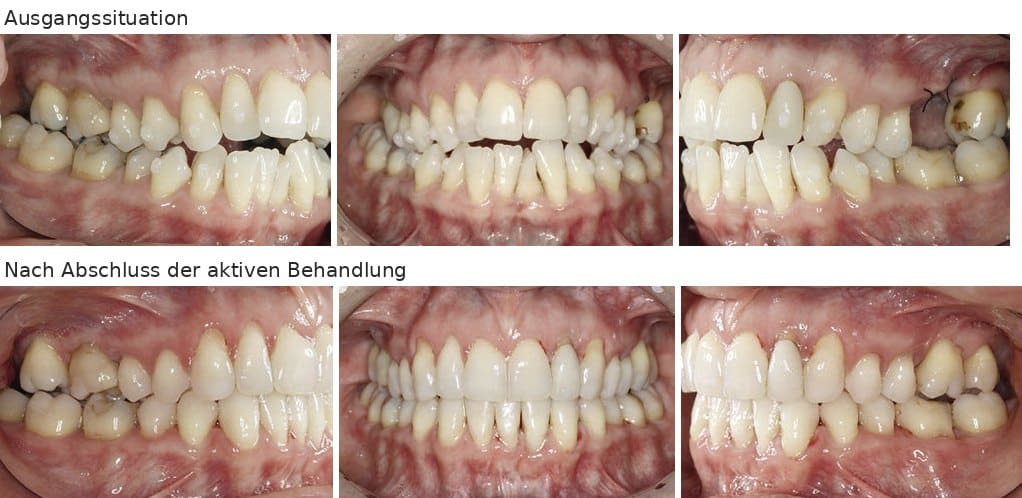
Not every open bite requires such effort. However, the example shows that even in adults, much is possible without surgery when the planning addresses all problems together from the outset. You can find the complete publication under Complex Cases: Aligners and Skeletal Anchorage.
How long does treatment for an open bite take?
Treatment duration varies individually and depends on the initial situation. For children who stop a habit early, a few months of guidance are sometimes sufficient. When the permanent front teeth are affected or the jaw is involved, active treatment takes one to three years depending on the findings, followed by the retention phase with retainers. Much depends on consistent cooperation — especially with removable appliances or aligners.
Open Bite and Aligners—Is That Possible?
For mild to moderate forms of an open bite, aligner treatment can be a suitable option. Whether this method is appropriate is carefully evaluated during our diagnostic process.
Open bite is one of the malocclusions that can relapse after treatment, especially if the tongue continues to push forward. That is why we plan the retention phase from the beginning: fixed or removable retainers and, where necessary, additional exercises for tongue and lips.
Cost of Treatment for an Open Bite
Costs depend on the type and extent of treatment. After a thorough examination, you will receive a transparent and individualized cost estimate at JUST KFO.
For children and adolescents under 18, the classification according to orthodontic indication groups (KIG) determines whether statutory health insurance covers the treatment. From KIG 3 onward: Statutory health insurance pays 80 percent of the costs directly; the patient’s 20 percent share is reimbursed after successful completion of treatment. For adults, statutory insurance covers only severe jaw misalignments treated in combination with surgery. Treatment with aligners is always a private service.
Private health insurance and Beihilfe reimburse according to the individual plan. We support you with the documentation for Beihilfe. If you wish, you can pay your share in interest-free installments directly through the practice for up to 18 months. Whether you have statutory or private insurance: diagnostics, consultation, and care are the same for all our patients.
Treating an Open Bite—Individual and Evidence-Based
An open bite is more than an aesthetic concern. With early and professional treatment, function, health, and quality of life can be sustainably improved.
At our practice JUST KFO, we guide you with modern diagnostics, years of experience, and individually tailored treatment concepts.
Please feel free to schedule an appointment for a personal consultation.
- Lentini-Oliveira, D. A., Carvalho, F. R., Rodrigues, C. G., et al. (2014). Orthodontic and orthopaedic treatment for anterior open bite in children. Cochrane Database of Systematic Reviews, (9), CD005515. https://doi.org/10.1002/14651858.CD005515.pub3
- Grippaudo, C., Paolantonio, E. G., Antonini, G., et al. (2016). Association between oral habits, mouth breathing and malocclusion. Acta Otorhinolaryngologica Italica, 36(5), 386–394. https://doi.org/10.14639/0392-100X-770
- Baratieri, C., Alves, M., de Souza, M. M. G., et al. (2011). Does rapid maxillary expansion have long-term effects on airway dimensions and breathing? American Journal of Orthodontics and Dentofacial Orthopedics, 140(2), 146–156. https://doi.org/10.1016/j.ajodo.2011.02.019
Frequently Asked Questions About Open Bite
How Do I Recognize an Open Bite?
An open bite is recognizable by the fact that the upper and lower teeth do not fully meet when biting down, and a visible gap remains between the dental arches. Especially in the front tooth area or the side teeth, contact is absent even when the mouth is closed.
What Causes an Open Bite?
The causes of an open bite are varied. They often arise from childhood habits such as thumb sucking, prolonged pacifier use, or tongue thrusting. Genetic predispositions and jaw growth disorders can also play a role.
How Is an Open Bite Treated?
Treatment depends on age, cause, and severity of the misalignment. In children, breaking harmful habits and using orthodontic appliances are often the focus. Adults can benefit from fixed braces, aligners, or in severe cases, surgical intervention.
How long does treatment for an open bite take?
Treatment duration varies individually. Active treatment takes one to three years depending on the findings, followed by the retention phase with retainers. Consistent cooperation, especially with removable appliances or aligners, contributes greatly to success.
Can an open bite also affect speech development?
Yes, an open bite can lead to speech disorders because the tongue often moves into the gap between the front teeth during speaking. This can make it difficult to pronounce certain sounds and may require speech therapy.
How long does it take for an open bite to resolve?
In young children, an anterior open bite can resolve on its own if the cause – usually thumb sucking, pacifier use, or incorrect tongue posture – is eliminated before the permanent incisors erupt. This often takes several months to a few years and can be supported with vestibular screens or myofunctional therapy. Once the permanent teeth have erupted or if the jaw itself is involved, an open bite will no longer resolve on its own; in that case, orthodontic treatment is necessary, which takes one to three years depending on the findings. In adults, there is no resolution without treatment.
Does health insurance cover treatment for open bite?
For children and adolescents under 18, this depends on the KIG classification. From KIG 3 onwards, statutory health insurance covers 80 percent of the costs directly; the 20 percent patient contribution is reimbursed after successful completion of treatment. Aligners are always a private service. For adults, statutory insurance only covers severe cases that are treated together with surgery.

Dr. Julia Steinmaier
Specialist in orthodontics. Owner of JUST KFO in Cologne, sought-after speaker and author who regularly appears in professional publications and media.
Full profile →Related Posts
These blog posts might also interest you.
 Feb 14, 2026Recognizing and Treating Crossbite – Why Early Action Is So ImportantRead more →
 Feb 21, 2026Does Tooth Position Affect Speech Development in Children?Read more →Nov 25, 2025Misaligned Teeth: Causes and PreventionRead more →
Reviewed by Dr. med. dent. Julia Steinmaier, specialist in orthodontics · Last reviewed on June 5, 2026
Your orthodontist in Cologne!
Schedule your no-obligation consultation at JUST KFO – Dr. Steinmaier & Kollegen in Cologne.