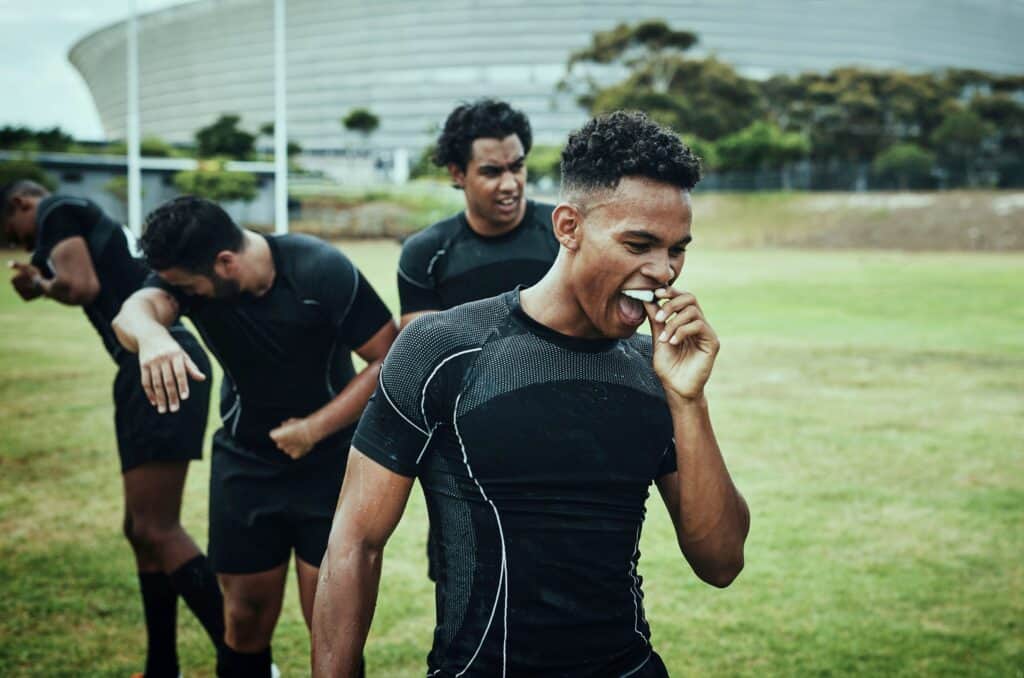
What this is about: Braces and sports, plus the right mouthguard. For everyday life with braces, see Braces in Everyday Life; for emergencies, see Braces Emergency. For mouthguards: Sports Mouthguard.
Many children and adolescents wear braces today and are physically active at the same time — whether in clubs, at school, or during leisure time. In principle, braces and sports are not mutually exclusive. A well-fitted sports mouthguard significantly reduces the risk of injuries to teeth, lips, and braces, though it cannot eliminate the risk entirely. Nevertheless, there are several important points that parents, children, and adolescents should keep in mind to prevent injuries, avoid damage to braces, and ensure that orthodontic treatment is not compromised.
At our orthodontic practice, we regularly provide guidance on how athletic activity can be safe even with braces.
Sports with braces — is that problematic?
In most cases, children with fixed braces or aligners can participate in sports without problems. Physical activity even has positive effects on overall health, balance, and well-being. However, the type of braces as well as the sport and its associated injury risk are decisive factors.
Caution is advised for sports that involve falls, collisions, or physical contact. This is especially true for children with significantly protruding upper front teeth: they injure their front teeth more frequently.5
Which sports are unproblematic?
Sports with a low risk of injuries to the mouth and facial area are usually well compatible with fixed braces or removable aligners, for example:
-
Swimming
-
Dancing
-
Jogging or endurance training
Here, a mouthguard is usually not necessary. However, for cycling, gymnastics, or the jumping and throwing disciplines in track and field: falls can occur, and the American Dental Association recommends a mouthguard for these as well.1 Whether it makes sense for your child, we will discuss during the consultation.
High-risk sports and braces
In contact sports or ball sports with high physical contact, there is an increased risk of injuries to the teeth, gums, oral mucosa, and braces. These include, among others:
-
Soccer
-
Handball
-
Basketball
-
Martial arts such as boxing or judo
-
Hockey
-
Skateboarding or inline skating
Especially with fixed braces, impacts can lead to loose brackets or injuries to the lips and cheeks. In boxing, a mouthguard is mandatory anyway. With fixed braces, it must also provide additional room for the brackets; in martial arts and hockey, an individually fitted guard is therefore essential.
The right protection: sports mouthguard for athletics
An individually fitted sports mouthguard is strongly recommended for many sports. It protects:
-
Teeth and braces
-
Lips, cheeks, and oral mucosa
-
Jaw and temporomandibular joint
In our practice, we are happy to advise you on which dental protection is suitable for your child and whether custom fabrication makes sense. Ready-made mouthguards from sporting goods stores offer basic protection, but are less suitable for braces wearers.
The American Dental Association summarizes the research as follows: Those who wear a properly fitted mouthguard experience significantly fewer dental and facial injuries — a 2019 meta-analysis reports 82 to 93 percent fewer than without. The ADA describes off-the-shelf products without custom fitting as the least effective option, because they fit poorly and do not stay in place.1 There is also an international guideline from IADT and ASD on preventing dental injuries in sports.2
What matters for mouthguards during treatment
A mouthguard for braces wearers has a special characteristic: the teeth move during treatment. A guard that fits snugly today may press or hinder the planned tooth movement in a few months. Over fixed brackets, it also needs some room so it does not lock onto wires and brackets. Self-formed mouthguards from sporting goods stores, which are softened in hot water and then pressed over the teeth, conform tightly around the brackets and are therefore not the first choice during fixed treatment. In a laboratory test on a model with fixed braces, several mouth-formed ready-made mouthguards shifted upon impact, while the individually fabricated ones did not.4
At JUST KFO, we capture the teeth with an intraoral scanner, without impression trays. We then fabricate the sports mouthguard in our in-house master dental laboratory in the same building, with sufficient space for the brackets. Because the tooth position changes continuously during treatment, we discuss when it needs to be readjusted depending on the treatment stage; therefore, bring it to your check-up appointments. Tell us during the consultation which sport and how many times per week your child needs it. You will receive the amount in writing before fabrication.
Fixed or removable braces — are there differences?
Sports with fixed braces
With fixed braces, the injury risk is higher because brackets and wires can put pressure on the mucous membranes in the event of an impact. A proper sports mouthguard is especially important here to avoid damage to the appliance and injuries.
Sports with removable appliances
Removable braces should generally be removed before sports and stored safely to prevent damage. Exceptions apply if your orthodontist recommends otherwise.
Sports with aligners
Whether your child or you wear aligners, the same applies: For sports without physical contact, such as jogging or swimming, aligners can remain in the mouth. Drink only water during this, as sports drinks run under the aligner and remain there on the teeth. An aligner does not replace a mouthguard, as it is too thin for that. For contact and ball sports, remove the aligners and wear a custom-fabricated sports mouthguard instead. The removed aligner belongs in its case, not in the jersey pocket.
What to do in case of pain or injuries?
After an impact or fall, the mouth should be carefully examined. If pain, loose brackets, bent wires , or other injuries occur, we recommend:
-
Pausing sports for the time being
-
Immediately sending a message to the orthodontist or dentist
-
Not attempting any repairs yourself
This helps prevent further damage and allows treatment to continue safely.
Tooth broken or knocked out: what counts in the first minutes
The international guidelines of the International Association of Dental Traumatology (IADT) provide clear steps for a knocked-out permanent tooth.3
-
Find the tooth and touch it only by the crown, never by the root.
-
If it is dirty, rinse briefly (no more than about ten seconds) under cold water, do not scrub.
-
If possible, immediately place it back into the socket and have them bite on a tissue. If that is not possible, store the tooth in milk, in a tooth rescue box, or in saline solution, not in tap water and not dry.
-
Immediately seek a dental practice or the emergency dental service. Bring broken pieces of a tooth crown along.
A knocked-out baby tooth is not replanted. After initial care, please also contact us at 0221 93 53 020 so we can check whether brackets, wire, or treatment plan need to be adjusted. A tooth rescue box is available at pharmacies; it is well kept in the sports bag.
Braces, sports, and motivation
So that braces do not become a reason to skip training, small routines help: The mouthguard is kept in its own case firmly in the sports bag, the coach knows about the braces, and after training, teeth and braces are briefly rinsed with water. In the first days after placing or adjusting fixed braces, there is often pressure; then a calmer training session is a good choice.
Braces and sports – expert guidance at JUST KFO
At our orthodontic practice, we support children, adolescents, and adults not only medically but also in everyday life with braces. We take time for your questions and provide clear recommendations on nutrition, cleaning, protection, and safe training, so your child can remain active in sports safely and without worry.
Feel free to schedule an appointment for a personal consultation.
Frequently asked questions about sports with braces (FAQs)
Can my child continue all sports with fixed braces?
Yes, in principle sports are possible with fixed braces . However, for contact sports such as soccer, martial arts, or basketball, protective measures such as a custom-fitted sports mouthguard should definitely be used to prevent injuries and damage to the braces.
Why is a sports mouthguard especially important for people wearing braces?
A sports mouthguard protects not only the teeth but also the braces, gums, lips, and cheeks from injuries caused by impacts or collisions. Especially with fixed braces, it can prevent brackets or wires from injuring the oral mucosa.
Should a removable appliance or aligner be worn during sports?
Removable appliances should be removed before sports and stored in their case, unless we have agreed otherwise with you. Aligners can stay in your mouth during non-contact sports. They do not replace a mouthguard: for contact and ball sports, remove the aligners and wear a custom-fitted sports mouthguard instead.
What should I do if my child has pain or damage to the braces after a fall?
Stop playing sports, contact us or your dentist immediately, and do not attempt repairs yourself; details are in the section above titled “What to do in case of pain or injuries?” — for a knocked-out tooth, see the section on dental trauma.
How can I motivate my child to stay active in sports despite wearing braces?
With proper preparation, a suitable mouthguard, and attention to precautions, your child can continue to enjoy the sports they love. A positive attitude toward treatment and regular consultation with the orthodontist help keep motivation high.
What to do if a tooth is knocked out during sports?
Handle the tooth only by the crown, rinse briefly with cold water if dirty, and if possible reinsert it immediately. Otherwise, store it in milk, saline solution, or a tooth rescue box and go directly to a dentist or emergency service. Please also inform us afterward.
- American Dental Association. Athletic Mouth Protectors (Mouthguards). ADA Oral Health Topics, Stand 18.08.2025. ada.org – Athletic Mouth Protectors
- Abbott, P. V. et al. (2024). IADT and ASD guidelines for prevention of traumatic dental injuries: Part 3: Mouthguards for the prevention of dental and oral trauma. Dental Traumatology. https://doi.org/10.1111/edt.12925
- Fouad, A. F., Abbott, P. V., Tsilingaridis, G., et al. (2020). International Association of Dental Traumatology guidelines for the management of traumatic dental injuries: 2. Avulsion of permanent teeth. Dental Traumatology, 36(4), 331–342. https://doi.org/10.1111/edt.12573
- Harrington, C., Minhas, G., Papageorgiou, S. N., & Cobourne, M. T. (2022). What are the differences in protective characteristics of orthodontic mouthguards? An in vitro study. European Journal of Orthodontics, 44(1), 95–100. https://doi.org/10.1093/ejo/cjab023
- Magno, M. B., Nadelman, P., Leite, K. L. F., Ferreira, D. M., Pithon, M. M., & Maia, L. C. (2020). Associations and risk factors for dental trauma: A systematic review of systematic reviews. Community Dentistry and Oral Epidemiology, 48(6), 447–463. https://doi.org/10.1111/cdoe.12574

Dr. Julia Steinmaier
Specialist in orthodontics. Owner of JUST KFO in Cologne, sought-after speaker and author who regularly appears in professional publications and media.
Full profile →Related Posts
These blog posts might also interest you.
 Jun 20, 2026Braces & School/Daily Life for Teens: Tips for Eating and CareRead more →Jun 20, 2026Braces Emergency: Wire Poking, Bracket Loose — What to Do?Read more →
 Nov 25, 2025Removable Appliance: Care and Wearing Times OverviewRead more →
Reviewed by Dr. med. dent. Julia Steinmaier, specialist in orthodontics · Last reviewed on June 9, 2026
Your orthodontist in Cologne!
Schedule your no-obligation consultation at JUST KFO – Dr. Steinmaier & Kollegen in Cologne.