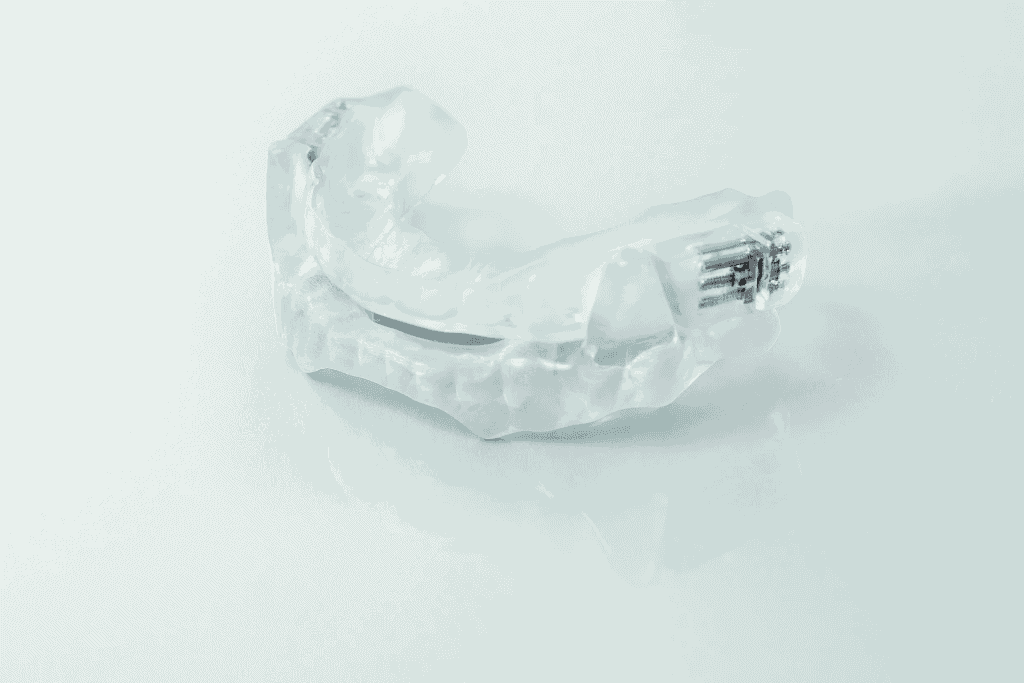
Almost one in three people in Germany snores. While many dismiss it as merely annoying, it can lead to strain and impairment over time. That’s when a custom-fabricated mandibular advancement device comes into play. More about our oral appliances from our laboratory. What it is, what advantages it offers, and what to keep in mind when using it is explained in this article.
Snoring: Still Often Underestimated
Snoring is an underestimated issue. Many people suffer from it — and not only because of the noise disturbance when a partner snores. In many cases, there is also a health risk. Therefore, snoring should not be taken lightly.
Snoring can manifest in different ways. Some people snore only lightly, while others suffer from sleep-related breathing disorders with breathing pauses such as sleep apnea. This leads to further complaints such as daytime fatigue, heart disease, and high blood pressure. Microsleep is also a common risk. In addition, sleep apnea patients are at greater risk of suffering a stroke.
Snoring is widespread, and sleep apnea is not always the cause. Middle-aged and older adults are particularly affected. The German Society for Sleep Research and Sleep Medicine (DGSM) reports the prevalence in this group as 20 to 50 percent for men and up to 25 percent for women.
Children can also snore. Some of them snore regularly. This significantly reduces the restorative quality of sleep. In addition, children are then tired during the day and suffer from difficulty concentrating. A healthy organism also requires sufficient oxygen. Snoring may result in inadequate oxygen supply.
How Does Snoring Occur?
Snoring is triggered by a narrowing of the airways. Various causes can be behind this. When the tongue muscles relax so that the tongue slips back into the throat, the airway becomes narrowed.
This creates air turbulence and vibration. The classic snoring sound results. This is also called tongue-base snoring. However, there can be other causes, such as:
-
Allergies
-
Jaw and dental misalignments
-
Enlarged tonsils
-
Anatomical features of the nose
-
Soft palate and enlarged uvula
By far the most common form of snoring is tongue-base snoring. Depending on the cause, a different treatment is naturally required. For tongue-base snoring, there is a good therapy: the mandibular advancement device.
Mandibular Advancement Devices: The Solution for Snoring
In some cases, a mandibular advancement device can provide relief. When snoring is caused by the tongue falling back into the throat, it is the optimal solution. It is also called a mandibular repositioning appliance.
Tongue-based snoring is one of the most common forms of snoring. With a properly fitted mandibular advancement device, not only can snoring be treated — it is also a popular treatment method for mild to moderate sleep apnea.
An anti-snoring appliance is fabricated based on an impression of the patient’s teeth. This ensures a perfect fit in the mouth and allows it to achieve the desired effect. The oral appliance holds the lower jaw, tongue, and soft palate forward during sleep.
In this way, the airway remains wide open, and the relaxed throat muscles are stabilized. The lungs receive sufficient air, allowing the blood to absorb enough oxygen. A mandibular advancement device can improve your overall health.
We at JUST KFO are happy to advise you on a custom oral appliance. We are specialists in snoring and sleep apnea. As your dental experts, we are here to support you with advice and assistance.
Advantages of Oral Appliances
The greatest advantage of 3D-printed mandibular advancement devices is that they promote healthy sleep. Sleep deprivation and poor sleep quality can have serious long-term consequences. People with sleep apnea in particular face significant health risks. A mandibular advancement device can help reduce these risks.
A major benefit of 3D-printed models is that they can be individually customized to the patient’s dentition. This eliminates the need for a one-size-fits-all standard solution. Instead, you receive a product created specifically for you that can support you without compromise.
Inserting and wearing an oral appliance is very simple. It can be compared to a removable appliance . Since it is worn only at night during sleep, patients are not affected by it when speaking or eating.
There are many tips and products for snoring and sleep apnea. However, the mandibular advancement device stands out with a short adjustment period and effective results. Additionally, it does not cause the disturbance associated with a CPAP mask used in positive airway pressure therapy.
In severe cases, however, the mask is unavoidable. Sleep apnea should always be examined by a specialist.
Types of Oral Appliances: What Options Are Available?
There are the following types of oral appliances:
-
Monoblock appliances: They consist of one piece for both upper and lower jaw.
-
Biblock appliances: They consist of two separate pieces — one for each jaw.
While monoblock appliances are quite simple to use, the biblock appliance requires an adjustment period at first. During this adjustment phase, jaw pain may occur. In the long term, however, it impresses with its flexibility. The appliances are connected with flexible joints or elastic bands.
Mandibular advancement devices are made from plastics of varying hardness. Inexpensive models are only available in standard sizes. There is then little room to adapt the device individually to the jaw.
High-quality anti-snoring devices are custom-made for each patient. Thanks to 3D printing technology, a device can be fabricated based on a digital impression .
Another option is boil-and-bite devices. They are made from a thermoplastic material. The device is heated in a water bath and molded so that it is individually adapted to the dentition.
At JUST KFO , you will receive a high-quality mandibular advancement device from our in-house master dental laboratory. We rely on the high standards of 3D printing technology. This allows us to offer you high quality and precision.
Using a 3D-printed mandibular advancement device: What should you watch out for?
Generally, a 3D-printed mandibular advancement device only helps people who suffer from tongue-base snoring. Those who have already lost many teeth or wear a removable denture cannot use the device. It is also not recommended for those with a severe overbite.
In order to wear a mandibular advancement device, the teeth must be able to withstand a certain amount of pressure. An examination by a dentist is therefore essential before using a device for snoring.
Furthermore, an anti-snoring device does not help with every type of snoring. Depending on the cause, the device may have no effect. It is therefore essential to know exactly where the snoring comes from in each individual case.
Those who snore and grind their teeth can combine a mandibular advancement device with a night guard. However, this should be clarified on a case-by-case basis.
For maximum hygiene, you should clean the 3D-printed mandibular advancement device after each use. It is best to clean it with a manual toothbrush. Placing the device in a denture cleaning solution is suitable for cleaning areas that are not reachable with the brush.
Adjustment period with mandibular advancement devices
Getting used to a mandibular advancement device is a matter of individual variation. We have a few tips for you that will help you get through the first period with your new device more quickly and easily:
-
Wear the mandibular advancement device in the evening to get used to it gradually. If you insert it only shortly before going to bed, it may cost you sleep. It is ideal to wear the device while watching television. This way you are distracted and not constantly thinking about the sensation in your mouth.
-
Be patient. At the beginning, wearing the device can be quite uncomfortable. Give yourself time to adjust to the changed situation.
-
Don’t overdo it. Of course, a mandibular advancement device can only help if you wear it all night. For the beginning, however, it is sufficient to wear the device in 10-minute intervals and later for hours at a time.
-
Stay in touch with your doctor. If you have questions or concerns, discuss them with your treating dentist. We at JUST KFO are here for you if you are unsure about using the appliance and need help.
Snoring: When to See a Doctor?
When a mandibular advancement device makes sense and when you should have your snoring examined is difficult for many people to assess. Some don’t even notice that they snore heavily. Often, it’s the partner who notices it. However, there are a few signs that indicate a visit to the doctor is advisable.
If you don’t feel rested after sleeping, suffer from daytime fatigue, and notice your ability to concentrate declining, you should get examined. A specialist can determine the cause of your snoring and initiate further steps. In some cases, the path to a mandibular advancement device first leads through a sleep laboratory.
When a 3D-Printed Mandibular Advancement Device Is Worth It
Mandibular advancement devices are an excellent way to counteract the negative effects of sleep apnea and prevent snoring. Compared to other solutions, they offer many advantages. We at JUST KFO are happy to advise you and find a solution that is individually tailored to you. This way, you can sleep peacefully and restfully again.
- Ramar, K., Dort, L. C., Katz, S. G., et al. (2015). Clinical Practice Guideline for the Treatment of Obstructive Sleep Apnea and Snoring with Oral Appliance Therapy: An Update for 2015. Journal of Clinical Sleep Medicine, 11(7), 773–827. https://doi.org/10.5664/jcsm.4858
- Marcus, C. L., Brooks, L. J., Draper, K. A., et al. (2012). Diagnosis and Management of Childhood Obstructive Sleep Apnea Syndrome. Pediatrics, 130(3), 576–584. https://doi.org/10.1542/peds.2012-1671
- Baratieri, C., Alves, M., de Souza, M. M. G., et al. (2011). Does rapid maxillary expansion have long-term effects on airway dimensions and breathing? American Journal of Orthodontics and Dentofacial Orthopedics, 140(2), 146–156. https://doi.org/10.1016/j.ajodo.2011.02.019
- Deutsche Gesellschaft für Schlafforschung und Schlafmedizin (DGSM). Schnarchen des Erwachsenen – Patientenratgeber. dgsm.de
FAQ: Frequently Asked Questions About 3D-Printed Mandibular Advancement Devices
Which is the best anti-snoring device?
Generally, the best mandibular advancement device is one that is individually adapted to your needs. We at JUST KFO provide individual and precisely fitting solutions with our oral appliances.
What does a good mandibular advancement device cost?
If you choose a high-quality product from an experienced orthodontist, you should expect to pay between 1.000 and 2.200 Euro. If a medical prescription is available, your health insurance may cover the costs.
How effective are mandibular advancement devices?
Mandibular advancement devices help in most cases. They do not obstruct breathing, do not cause pain when worn, and only need to be worn at night.

Dr. Julia Steinmaier
Specialist in orthodontics. Owner of JUST KFO in Cologne, sought-after speaker and author who regularly appears in professional publications and media.
Full profile →Related Posts
These blog posts might also interest you.
 Jun 20, 2026Airway Orthodontics: What’s Behind It?Read more →
 May 7, 2025Malocclusion and mouth breathing: An often underestimated connectionRead more →Jul 17, 2026What Does a Dental Appliance Cost? Costs, Factors, and Insurance CoverageRead more →
Reviewed by Dr. med. dent. Julia Steinmaier, specialist in orthodontics · Last reviewed on September 6, 2026
Your orthodontist in Cologne!
Schedule your no-obligation consultation at JUST KFO – Dr. Steinmaier & Kollegen in Cologne.