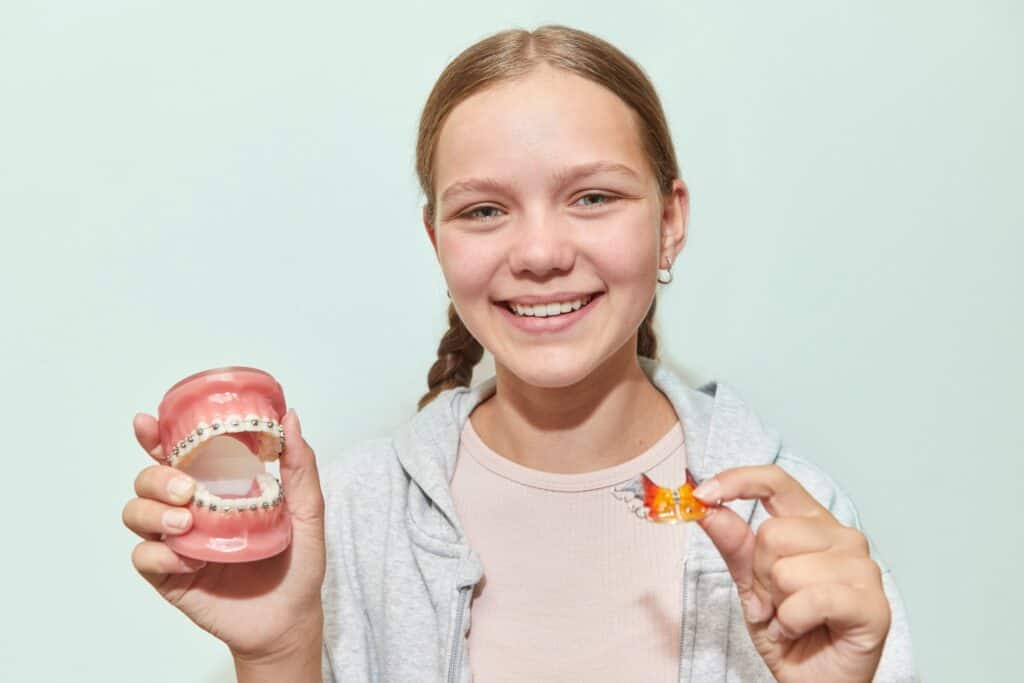
“Does My Child Need Braces?
When braces are necessary. How long treatment takes. What costs insurance covers”
Whether a child needs braces is not a matter of appearance but of function: Can they bite, chew, speak, and breathe through the nose properly – and is there enough space for the permanent teeth? We recommend the first orthodontic examination between ages six and nine, when the first permanent incisors and molars have erupted. Treatment typically occurs between ages eight and fourteen – and only if the clinical findings require it. This article shows you how to recognize treatment needs, when the right time is, and what statutory health insurance covers.
You can learn everything about orthodontics for children on our treatment page. Whether clear aligners are already an option is addressed in our article Can my child get clear aligners?.
The fact that children today are more frequently “wired” than in the past has several reasons: Parents place great importance on healthy and straight teeth. Furthermore, we now understand the harmful consequences of misaligned teeth and jaws better than before. And finally, most children today more readily accept braces because they are no longer considered a flaw among peers.
Even adults can receive orthodontic treatment. For you, there are invisible braces called aligners / Invisalign .
Go directly to our services for children’s braces:

Teeth Straightening – Just for Appearance?
Flawless teeth are a side effect for the orthodontist: they decide based on medical considerations whether the misalignment will later affect health. But what functions well and is healthy also looks good!
When Are Braces Really Necessary?
If individual teeth sit crooked in the jaw or the bite is incorrect because the upper and lower jaws do not fit together properly, this can soon have consequences: for example, stomach and intestinal problems due to poor chewing. Or speech defects, such as lisping.
If the teeth are crowded and crooked, it can also lead to increased cavities. Last but not least, the neck and jaw muscles, throat, and airways are stressed if the mouth is not properly closed at night during sleep.
What Are the Most Common Reasons for Treatment?
- Receding lower jaw: The upper front teeth protrude far in front of the lower front teeth.
- Protruding lower jaw: The lower incisors bite in front of the upper teeth.
- Crowding: The teeth do not stand in a proper arch but are tightly crowded together.
- Open bite: The back teeth bite together, but the front teeth do not – a gap forms in front.
The cause of such misalignments sometimes lies in genetics, but often the problems are self-inflicted: thumb sucking, nail biting, but also prolonged use of bottles or pacifiers as constant comfort lead to deformities. The still-soft upper jaw bones are pushed forward. As a result, the front teeth later protrude. It is also problematic if the baby teeth fall out too early due to cavities. The neighboring teeth then tilt into the gap that has formed, and the permanent teeth grow out crooked.
When should treatment begin?
Most children get their braces at eight or nine years of age, when the tooth transition has begun and jaw growth is still manageable. Exactly when the right time is depends on the findings – from what age braces make senseis described in detail there.
Correction is also very possible during adolescence – fixed braces are usually placed between ages twelve and fourteen, once all permanent teeth have erupted. What matters at this age is cooperation: elastic bands, oral hygiene, and keeping appointments determine success. Early treatment at ages five to eight is the exception and is intended for a few clearly defined conditions – such as crossbite, pronounced overjet with risk of injury to the incisors, or habits like thumb sucking (Fleming 2017, see Sources).
According to the Professional Association of German Orthodontists (BDK) , many children could be spared a lengthy procedure if parents would take their child to a specialist in orthodontics as early as five to six years old. Misalignments detected early can often be treated with playful (myofunctional) muscle exercises or simple measures such as a vestibular screen or functional regulators.
Starting treatment late carries the risk that braces can usually no longer be avoided. Sometimes teeth must be extracted, or even surgery may be necessary.
How do you keep braces clean?
Children with braces need intensive oral hygiene:
Before brushing, rinse vigorously with water or a special solution. This removes larger food particles. Then brush the teeth carefully and systematically with small, circular movements.
Pay special attention to the gum line below and above the braces. Use a water flosser and special small “interdental brushes” to clean under and between the braces. Especially important: clean the spaces between teeth with dental floss every evening.
Clean removable appliances under running water with a toothbrush. With daily care, this works without cleaning tablets.
The professional associations of orthodontists and pediatricians have therefore decided on closer cooperation. According to an interdisciplinary program, the pediatrician examines children at ages 3, 5, and 7 also orthodontically and screens preventively for tooth and jaw misalignments.
How long does treatment take on average?
Normally, the child must wear braces for several years. Even if the teeth can be brought into the desired position soon—they slide back just as quickly.
Whether the child receives a removable or a fixed appliance depends on the orthodontist’s diagnosis. Only few misalignments can be corrected with either system. Depending on the type of misalignment, the child receives fixed brackets, removable appliances or so-called non-compliance devices, appliances that move teeth without requiring the child’s cooperation.
Why the appliance after the braces?
Many children need to wear a removable appliance for some time even after the fixed braces are removed. Unfortunately, teeth cannot be outsmarted that quickly: the period after orthodontic treatment, during which the teeth have been moved into the desired position, is called the “retention phase.” Now the goal is to keep them in that position. How long this takes varies from patient to patient.
What costs are covered by health insurance?
Statutory health insurance covers treatment if a recognized treatment need exists. For this, the orthodontist assigns the findings to one of five orthodontic indication groups (Kieferorthopädische Indikationsgruppen, KIG) – from grade 1 (minor deviation) to grade 5 (very pronounced). From grade 3 onward, insurance pays; grades 1 and 2 are private services, even if treatment may be beneficial. The classification is made in the practice according to fixed measurements and is reviewed by the insurance.
If insurance covers it, it pays 80 percent of the costs directly. You initially pay the 20 percent co-payment yourself and receive it back after successful completion of treatment. Services beyond standard care – such as ceramic braces or certain aligners – are agreed upon separately. What applies in your case is outlined in the treatment and cost plan before treatment begins. For details on the classification: the KIG section on our page about fixed braces.
Summary:
Braces are increasingly used today in children and adolescents to correct misaligned teeth and jaws and promote healthy, straight teeth.
There are nearly invisible braces for adults, such as aligners or Invisalign. Depending on the diagnosis, treatment may involve a removable or fixed appliance, such as self-ligating brackets.
The optimal time for braces treatment in children is as soon as tooth replacement begins, since jaw growth is not yet complete. An orthodontic indication group is used to determine the necessity of treatment and coverage by statutory health insurance.
Fixed braces for children and adults are attached to the teeth using self-ligating brackets. Thorough oral hygiene is important for patients with fixed braces to prevent cavities and other problems.
After treatment with fixed braces, a removable appliance may be required, or the use of a retainer is recommended to keep the teeth in their corrected position.
Sources:
- Gemeinsamer Bundesausschuss. Richtlinie für die kieferorthopädische Behandlung (KFO-Richtlinie). g-ba.de/richtlinien/28 · § 29 SGB V. gesetze-im-internet.de/sgb_5/__29.html
- Fleming P. S. (2017). Timing orthodontic treatment: early or late?. Australian dental journal, 62 Suppl 1, 11-19. https://doi.org/10.1111/adj.12474
- DiBiase A. (2002). The timing of orthodontic treatment. Dental update, 29(9), 434-441. https://doi.org/10.12968/denu.2002.29.9.434
- Anne Mandall, N., Cousley, R., DiBiase, A., Dyer, F., Littlewood, S., Mattick, R., Nute, S., Doherty, B., Stivaros, N., McDowall, R., Shargill, I., Ahmad, A., Walsh, T., & Worthington, H. (2012). Is early Class III protraction facemask treatment effective? A multicentre, randomized, controlled trial: 3-year follow-up. Journal of orthodontics, 39(3), 176-185. https://doi.org/10.1179/1465312512Z.00000000028
- Kluemper, G. T., Beeman, C. S., & Hicks, E. P. (2000). Early orthodontic treatment: what are the imperatives?. Journal of the American Dental Association (1939), 131(5), 613-620. https://doi.org/10.14219/jada.archive.2000.0235
- Marques, L. S., Freitas Junior, N.d, Pereira, L. J., & Ramos-Jorge, M. L. (2012). Quality of orthodontic treatment performed by orthodontists and general dentists. The Angle orthodontist, 82(1), 102-106. https://doi.org/10.2319/061311-389.1
- Farret, M. M., Farret, M. M., & Farret, A. M. (2016). Orthodontic camouflage of skeletal Class III malocclusion with miniplate: a case report. Dental press journal of orthodontics, 21(4), 89-98. https://doi.org/10.1590/2177-6709.21.4.089-098.oar
- Brierley, C. A., DiBiase, A., & Sandler, P. J. (2017). Early Class II treatment. Australian dental journal, 62 Suppl 1, 4-10. https://doi.org/10.1111/adj.12478
- O’Brien, K., Wright, J., Conboy, F., Appelbe, P., Davies, L., Connolly, I., Mitchell, L., Littlewood, S., Mandall, N., Lewis, D., Sandler, J., Hammond, M., Chadwick, S., O’Neill, J., McDade, C., Oskouei, M., Thiruvenkatachari, B., Read, M., Robinson, S., Birnie, D., … Worthington, H. (2009). Early treatment for Class II Division 1 malocclusion with the Twin-block appliance: a multi-center, randomized, controlled trial. American journal of orthodontics and dentofacial orthopedics : official publication of the American Association of Orthodontists, its constituent societies, and the American Board of Orthodontics, 135(5), 573-579. https://doi.org/10.1016/j.ajodo.2007.10.042
- Antoun, J. S., Mei, L., Gibbs, K., & Farella, M. (2017). Effect of orthodontic treatment on the periodontal tissues. Periodontology 2000, 74(1), 140-157. https://doi.org/10.1111/prd.12194
- Eltern Ratgeber, Ausgabe 1/2002
- Deutsche Gesellschaft für Kieferorthopädie (DGKFO) & Deutsche Gesellschaft für Zahn-, Mund- und Kieferheilkunde (DGZMK): S3-Leitlinie Ideale Behandlungszeitpunkte kieferorthopädischer Anomalien. AWMF-Registernr. 083-038, Version 1.1 (Dezember 2021, gültig bis 16.12.2026). register.awmf.org
- Proffit W. R. & Fields H. W. (1993). Contemporary orthodontics (2nd ed.). Mosby-Year Book.
Editorial note (2026): This article is a reprint from ‘Eltern’ (issue 1/2002). Some information reflects the state of knowledge at that time; the annual number of children treated mentioned in the article is not substantiated at that level. What matters for treatment is always the individual orthodontic assessment.
Frequently asked questions about whether a child needs braces
How can I tell if my child needs braces?
Signs may include crowded or crooked teeth, a noticeable bite issue, difficulty biting, mouth breathing, or persistent thumb sucking. However, only an orthodontic examination can provide certainty — you don’t have to make this judgment yourself.
Are braces just about appearance?
No. Beyond a harmonious smile, braces are primarily about function and health: a properly functioning bite, effective oral hygiene, and healthy development of the jaws and jaw joints. Misalignments can cause long-term problems.
Does health insurance cover the cost for children?
For children and adolescents, statutory health insurance covers the costs if a certain severity of misalignment exists (KIG classification 3 to 5): it pays 80 percent directly, and you receive the 20 percent co-payment back after successful completion of treatment. In milder cases or for additional services, private costs may arise – we discuss this in advance.
Will braces be uncomfortable for my child?
In the first few days after placement, a feeling of pressure is normal and quickly subsides. Children usually adjust quickly. With good preparation and age-appropriate explanation, we help ease their concerns.

Dr. Julia Steinmaier
Specialist in orthodontics. Owner of JUST KFO in Cologne, sought-after speaker and author who regularly appears in professional publications and media.
Full profile →Related Posts
These blog posts might also interest you.
 May 5, 2023When to See an Orthodontist: Optimal Treatment Timing for ChildrenRead more →
 Dec 15, 2024When Do Braces Make Sense? Tips and Guidance from ExpertsRead more →Jul 17, 2026What Is an Orthodontist? Training, Credentials, and DistinctionsRead more →
Reviewed by Dr. med. dent. Julia Steinmaier, specialist in orthodontics · Last reviewed on September 6, 2026
Your orthodontist in Cologne!
Schedule your no-obligation consultation at JUST KFO – Dr. Steinmaier & Kollegen in Cologne.